Randomly Rudimentary Life Stuff
Learning to live authentically, and not settling for substitutes or counterfeits, and sharing those thoughts
Are the Gates of Hell Prevailing?
Or Do We Just Not Know What They Won’t Prevail Against?
By LONNIE KING
There’s a verse in the Bible that gets quoted a lot whenever modern Christianity feels threatened.
Jesus tells Peter:
“Upon this rock I will build my church; and the gates of hell shall not prevail against it.” (Matthew 16:18, KJV)
For many people in modern American Christianity, that verse has become a kind of institutional battle cry. A reassurance that Christianity itself cannot fail. That churches cannot truly lose. That criticism, decline, cultural pushback, shrinking attendance, deconstruction, or loss of political power are all ultimately temporary because God promised victory.
But lately I’ve been wondering about something uncomfortable: what if we don’t actually understand what Jesus meant when he said it?
Maybe “Church” Isn’t What We Think It Is
Part of the problem may be the word church itself.
When most modern Americans hear the word church, they think of denominations, buildings, pastors, organizations, political lobbying, doctrinal systems, religious branding or institutional Christianity.
But the word Jesus used was ekklesia.
That word carried a much different meaning than what many of us picture today. It referred more to an assembly, a gathered people, a community called together around a shared purpose and identity.
In other words, Jesus may not have been talking about an institution at all.
He may have been talking about a movement. A way of living. A way of seeing. A way of loving. A way of embodying grace, mercy, humility, justice, compassion, and truth in the world. And if that’s what he meant, then maybe we’ve spent centuries applying his promise to things he never promised to preserve.
The Institutional Shield
What troubles me most is how often this verse gets used almost like a weapon now.
- Question the church? “The gates of hell will not prevail.”
- Criticize corruption? “The gates of hell will not prevail.”
- Challenge Christian nationalism? “The gates of hell will not prevail.”
- Leave toxic theology behind? “The gates of hell will not prevail.”
At times, the verse gets wielded less as a source of hope and more as a warning: “You can’t fight us because God is on our side.”
But institutions are not automatically righteous simply because they invoke the name of Jesus.
In the Bible itself, prophets challenged religious systems constantly. Jesus himself repeatedly confronted religious leaders who had become more invested in power, appearances, and control than compassion or humility. So, I struggle with the assumption that resisting corrupted religious institutions is somehow equivalent to resisting God.
I don’t think those are the same thing at all.
Citizens of Heaven…Or Defenders of Empire?
One of the tensions I cannot escape is that the New Testament repeatedly describes believers as ambassadors, sojourners, pilgrims, strangers in a foreign land or citizens of another kingdom.
Jesus himself said, “Render to Caesar the things that are Caesar’s, and to God the things that are God’s.” (Mark 12:17, KJV)
And over and over again, his disciples seemed to misunderstand him because they expected a political revolution. They expected earthly dominance. They expected him to establish an earthly kingdom and overthrow Roman power.
Instead, Jesus talked about serving. About loving enemies. About caring for the vulnerable. Rejecting violence. Giving up power rather than seizing it.
That doesn’t sound much like modern culture-war Christianity to me.
And yet so much of American evangelicalism today feels deeply invested in controlling institutions, legislating morality, winning political battles, enforcing religious identity, and defending cultural dominance.
Sometimes it feels less like an ekklesia and more like an empire trying desperately to survive.
Maybe Institutions Can Fail
That’s why I keep gravitating back to this thought: what if the “gates of hell” promise was never about preserving institutions from decline?
- What if churches can shrink?
- What if denominations can fracture?
- What if religious systems can corrupt themselves?
- What if entire movements carrying the name “Christian” can lose their way?
And what if none of that disproves the teachings of Jesus?
Maybe the enduring thing was never supposed to be the machinery. Maybe it was the spirit of the movement itself—the compassion, the mercy, the grace, the dignity of human beings, the refusal to dehumanize enemies and the insistence that love matters more than domination.
Maybe that is what the gates of hell cannot overcome.
A Hard Question I Can’t Shake
I don’t know exactly where all of this leaves me.
I still find myself drawn to the teachings of Jesus. I still believe there is something enduring and transformative there. But I no longer assume every institution claiming his name automatically represents him well.
And honestly, I’ve concluded that maybe that realization isn’t rebellion against God at all.
Maybe sometimes questioning institutions is the only way to rediscover the difference between the institution and the ekklesia. Maybe the gates of hell are not prevailing even if institutions are struggling.
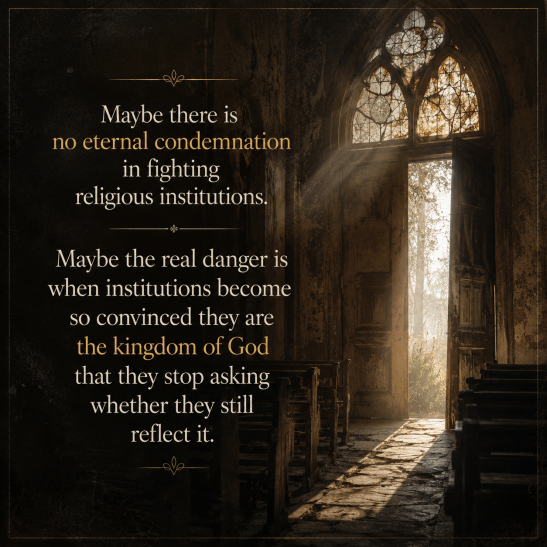
And, maybe there is no eternal condemnation in fighting religious institutions. Maybe the real danger is when institutions become so convinced they are the kingdom of God that they stop asking whether they still reflect it.
Grace and grit to you! –LK