
Randomly Rudimentary Life Stuff
Learning to live authentically, and not settling for substitutes or counterfeits, and sharing those thoughts
I Knew the Answer Before I Knew There Was a Question
By LONNIE KING
I knew Israel became a nation in 1948 before I was ten years old.
I’m pretty sure I couldn’t have told you much about the aftermath of World War II. I didn’t understand the Holocaust beyond the broadest terms. I certainly knew nothing about the British Mandate, the Zionist movement, Palestinian displacement or the competing claims to a relatively small piece of land on the other side of the world.
But I knew 1948.
Why would a young kid in 1960s Texas know that? Because I learned it in church.
In the fundamentalist Christian world in which I grew up, 1948 wasn’t simply a date in modern history. It was a date on God’s calendar.
Israel had become a nation again. Prophecy was being fulfilled. And Jesus was coming back.
The Clock Was Ticking
There was serious discussion in evangelical circles of my childhood about what Jesus meant when he said “this generation shall not pass” before the events he described were fulfilled.
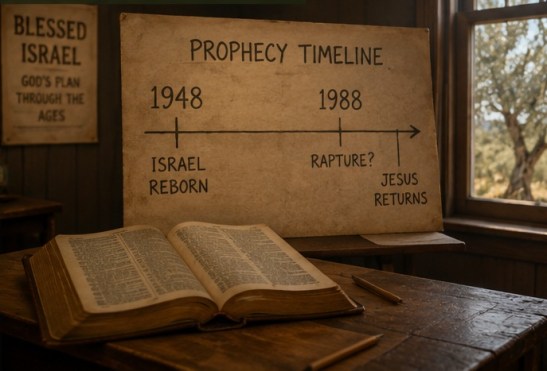
A generation, we were told, could be understood as 40 years. Israel was restored in 1948 and you can do the math from there.
By the time 1988 arrived, Edgar Whisenant had done considerably more than the math. He published a book called 88 Reasons Why the Rapture Will Be in 1988. My dad owned a copy.
I want to be fair to him here, because this matters: owning the book didn’t mean he bought its conclusion.
For all the complications my fundamentalist upbringing created for me later, reducing God to a manmade timetable wasn’t one of them. My dad was skeptical that somebody had figured out God’s calendar well enough to circle a date.
Looking back, maybe that skepticism gave me something more valuable than either of us realized.
If somebody could write an entire book confidently explaining when God was going to do something, and my dad could look at it and essentially say, I’m not so sure about that, then perhaps religious certainty wasn’t quite as certain as it sounded.
Maybe “How do we know that?” was a legitimate question. I do know it’s definitely a dangerous question once you learn how to ask it, because it doesn’t always stay where you put it.
1988 Came and Went
Jesus did not return in 1988. Now, here we are, nearly another 40 years later…

But something I’ve been thinking about lately is that while 1988 came and went, some of the theology that got us there didn’t.
The prophetic significance attached to modern Israel remained deeply embedded in much of American evangelical Christianity. And some of the children who learned those lessons alongside people like me grew up still believing them.
Some eventually entered politics. Some became policymakers. Some gained influence over American foreign policy.
That’s where a childhood Sunday School lesson suddenly becomes something more than an interesting piece of my religious autobiography. Because here’s a question I don’t remember anyone encouraging me to ask when I was a kid:
When did Christianity decide that Israel had to become a modern sovereign nation in order for biblical prophecy to be fulfilled?
I’m not asking whether Israel has a right to exist. That’s a different question.
I’m not questioning the reality of centuries of persecution endured by Jewish people, the horror of the Holocaust or the understandable desire for a place where Jewish people could exercise self-determination and live in safety.
I’m asking a specifically ‘Christian’ question: when did the existence of a modern State of Israel become a prerequisite for the return of Jesus? And who decided that’s what the Bible meant anyway?
I used to know that answer before I ever knew there was a question. But now I’m learning to ask the question.
When Prophecy Meets Policy
This becomes more consequential when religious belief leaves Sunday School and enters the halls of government.
There are plenty of reasons for the United States to have a relationship with Israel that have nothing to do with biblical prophecy: history, security, diplomacy, strategic interests and our longstanding relationship with the Israeli people.
But some American Christians believe something more. They believe the modern State of Israel occupies a particular place in God’s prophetic plan. And that leaves me wondering something I never thought to wonder as a child:
At what point does believing you’re watching prophecy unfold become helping create the conditions necessary for your interpretation of the prophecy to come true?
I don’t know the answer and I don’t want to make the sensational claim that all evangelical Christians in Washington are deliberately trying to manufacture Armageddon. That’d be too easy, and I’m not certain it’s fair. They might just be ignorant.
But, to me, this much is clear: our beliefs have consequences.
If I believe certain geopolitical developments are not merely possible, but are divinely ordained, doesn’t that belief affect the way I respond when those developments occur?
If I believe a particular piece of land ultimately belongs to Israel because God promised it thousands of years ago, doesn’t that affect how I view the Palestinian family living on that land today?
If conflict itself fits into my understanding of prophecy, won’t I be less alarmed by the escalation of war than I otherwise would?
Those seem like questions worth asking when the people holding those beliefs have the ability to influence what the United States does. Especially because real human beings live inside what we sometimes casually call “prophecy.”
Then I Learned About an Olive Farmer
I read recently read about a Palestinian olive farmer. His name is Yousef Dar al-Musa.
His family farm is in the West Bank and his family has grown olives there for generations. He was 67 when he described what happened during the 2025 olive harvest. He said Israeli settlers violently attacked him to prevent him from reaching his family’s land.
The olive harvest isn’t a hobby. Selling olive oil is how families like his support themselves through the year.
His trees had fruit, but he couldn’t safely pick it. And when I read his story, my moral reaction should have been the simplest and most understandable thing in the world: That’s wrong.
Yet I realized there was still a tiny bit of resistance somewhere inside me. Not resistance to the facts. Resistance to saying the words out loud. Actually, a bit of resistance thinking those things—much less expressing those thoughts.
Why? Because this was Israel. And somewhere deep underneath 55 years of accumulated experience was still that little boy who knew what happened in 1948.
Israel was God’s chosen people. Israel was prophecy. Israel was ‘God’s side.’ And now, as a nation, they were back. And criticizing that nation could therefore feel uncomfortably close to criticizing God.
That’s when I realized how much unlearning I still have to do.
Grace for Us, Explanations for Them
I’ve seen a similar instinct in other parts of the Christian world. When allegations of sexual abuse have arisen against respected clergy, Christians have sometimes demonstrated an extraordinary capacity for extending grace to the accused.
- “We need to know the whole story.”
- “Don’t destroy a man’s ministry.”
- “Everyone makes mistakes.”
- “What was she doing there?”
- “Why didn’t she speak up sooner?”
The situations aren’t equivalent, and I’m not suggesting they are. The instinct to make excuses for someone we perceive is called by God for something sacred, however, can be remarkably similar.
When someone inside a group we’ve already associated with righteousness causes harm to someone outside it, we can become very creative in finding mitigating circumstances for the insider.
When it’s ‘us’, context explains wrongdoing. When it’s ‘them’, wrongdoing reveals bad character.
I’ve participated in that way of looking at the world myself. That’s why I’m uncomfortable with it now.
A Country Is Not God
Modern Israel is a nation. It has citizens and politicians. Elections and political parties. Soldiers and activists. Conservatives and liberals. Religious people and secular people. People working desperately for peace and people who seem determined to make peace impossible.
In other words, it is populated by human beings. Human beings are capable of extraordinary goodness. They’re also capable of terrible things.
Being supportive of Jewish people doesn’t require pretending otherwise. Opposing antisemitism doesn’t require pretending otherwise. Believing Israel has a right to exist doesn’t require pretending otherwise. And condemning what Hamas did on October 7 doesn’t require pretending otherwise.
Murdering Israeli civilians is wrong. Taking hostages is wrong.
But then, attacking Palestinian civilians is wrong. Driving people from their homes is wrong. Beating an elderly farmer and preventing him from harvesting the crop that supports his family is wrong.
I don’t need to solve 2,000 years of Christian eschatology before I’m allowed to say any of those things.
The People Living Inside Our Prophecies
That’s perhaps what troubles me most as I revisit the theology I inherited.
When we turn the Middle East into a prophetic chessboard, it’s easy for the people living there to become pieces.
Israel must do this. The Arab nations must do that. This territory must belong to these people. This conflict must happen before that event can happen. And somewhere beneath all those arrows on the prophecy chart is a farmer who just wants to pick his olives.
There are Israeli parents who want their children to come home safely. There are Palestinian parents who want exactly the same thing. And, there are Jewish people, Muslims, Christians and people with no particular religious belief trying to live ordinary lives in a place the rest of us have spent centuries turning into an abstraction.
Maybe God has a timetable…I don’t know.
My dad, the Baptist preacher, was wise enough to be skeptical of anyone who claimed to have figured it out. I’m becoming increasingly skeptical of anyone who believes they know and have decided our job is to help move the hands on the clock closer to the departure time.
Finally Asking the Question
I’m not trying to replace everything I learned as a child with its opposite. That’s not unlearning. That’s just trading one form of certainty for another.
I’m trying to give myself permission to examine things I once thought I wasn’t allowed to examine.
I can still believe things I was taught. I can reject some of them. I can modify others. And sometimes I can simply say, I don’t know. But I no longer want an interpretation handed to me before I was ten years old determining whose suffering I’m allowed to see at 65.
Maybe that’s the biggest thing I’m unlearning.
I knew the answer before I knew there was a question. But, now I know there are questions. Difficult questions. And if I’m certain of anything anymore, it’s that my faith isn’t threatened by asking them.
Perhaps faith that can’t survive the questions isn’t nearly as strong as we’ve been led to believe it is.
And perhaps before I worry about where a Palestinian olive farmer fits on somebody’s prophecy chart, I should see him for what he was all along: my neighbor.

