
Randomly Rudimentary Life Stuff
Learning to live authentically, and not settling for substitutes or counterfeits, and sharing those thoughts
What Happens When Nobody Remembers the Enemy?
By LONNIE KING
I learned something about table salt recently.
That was not on my agenda. I did not wake up that weekend morning wondering about iodine deficiency. I had no plans to research the history of goiters. There was nothing on my to-do list suggesting that I devote part of a Sunday to investigating why the little container of salt in my kitchen says “iodized.”
But this is apparently how my brain works now.
I subscribe to an email newsletter called History Facts, which delivers exactly what the name promises: random bits of history that occasionally teach me something and, every once in a while, send me wandering down a completely unrelated rabbit hole.
The subject line this time? Merely a simple question: Why is table salt iodized?
I clicked. And several minutes later, I knew the answer.
Unfortunately, my brain has never been particularly good at leaving well enough alone.
The Enemy in the Salt Shaker
A century ago, iodine deficiency was a significant public-health problem in parts of the United States.
One of its most visible consequences was goiter, an enlargement of the thyroid gland that can cause a very noticeable swelling in the neck.
It was common enough that large sections of the northern United States became known as the “goiter belt.” During World War I, examinations of military recruits helped reveal just how widespread the problem was in certain regions.
But, the solution turned out to be almost ridiculously simple.
People need iodine. But in some parts of the country, they weren’t getting enough of it through their diets.
Salt was something almost everybody consumed regularly. So beginning in the 1920s, manufacturers started adding small amounts of iodine to table salt to increase the likelihood that people would get the benefits.
And here’s something else I didn’t know: in the United States, they weren’t even required to do it. And still aren’t.
Iodization of salt has remained voluntary. Manufacturers did it. People bought it. Along with other efforts to address iodine deficiency, it worked…remarkably well. The widespread problem of iodine-deficiency goiter diminished dramatically. And eventually something else disappeared with it:
Our memory of why the iodine was there in the first place.
Think about that. I am 65 years old. I have spent six and a half decades shaking iodized salt onto food without ever giving much thought to why somebody was putting iodine in it.
I knew iodine was there. I just didn’t know what enemy it was fighting.
And somewhere between reading about thyroid glands and looking at a salt shaker, another thought wandered into my head: polio.
We Used to Know What Polio Meant
For people of my generation, polio occupies an interesting place in history.
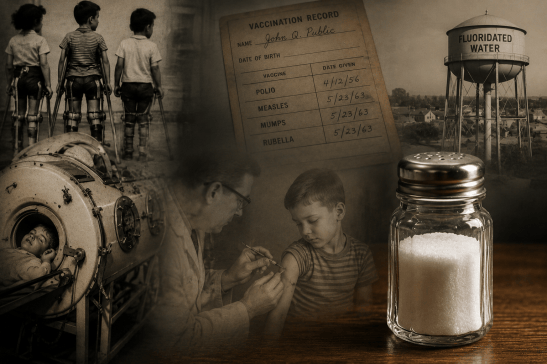
I’m old enough to remember getting the vaccine. I’m not really old enough to remember being afraid of the disease. But my parents certainly were.
Before widespread vaccination, polio outbreaks were a recurring nightmare in the United States. Thousands of people, many of them children, were paralyzed every year. Some died. Some survived only with mechanical assistance to breathe.
There were parents who feared swimming pools in the summer because polio outbreaks seemed to intensify during warmer months. There were quarantines. There were children in braces. There were iron lungs. There were families whose lives changed because a healthy child woke up sick and, within days, could no longer walk.
Then came the vaccines. And polio virtually disappeared from the United States.
That sentence is so easy to write that I think we sometimes fail to comprehend what an astonishing accomplishment it describes.
A disease that terrified American parents essentially vanished from everyday American life.
The vaccine worked so well that my children grew up without fearing polio. Their children are growing up without fearing polio. And therein lies a strange problem: they also grew up without seeing what polio did.
We Inherited the Victory, But Not the Memory
The same thing happened with measles. Before the measles vaccine became available in 1963, millions of Americans were infected during a typical year. Most survived, but tens of thousands were hospitalized. Some developed encephalitis. Hundreds died.
Rubella presents an even more sobering story. A major American rubella epidemic in 1964 and 1965 infected millions and resulted in miscarriages, infant deaths and thousands of babies born with congenital rubella syndrome, which could cause deafness, blindness, heart defects and intellectual disabilities.
Then we developed vaccines.
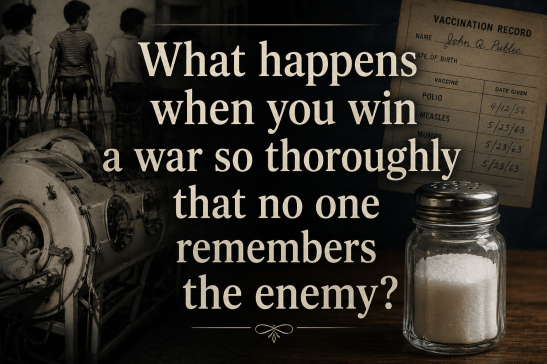
Eventually measles, mumps and rubella were combined into the familiar MMR vaccine. And once again, the defenses worked remarkably well. So well, in fact, that eventually we stopped seeing the enemy.
Which leaves me wondering: what happens when you win a war so thoroughly that no one remembers the enemy?
Maybe eventually people start wondering why we’re spending so much effort maintaining the defenses. Maybe the walls start looking unnecessary because nobody remembers what used to come over them. Maybe a vaccine begins to look like the greater threat because you’ve never seen the disease it prevents. Maybe iodine in salt seems like an odd chemical additive because you’ve never lived in a community where iodine deficiency was commonplace.
We inherited the victory, but not the memory of the enemy. And I wonder whether that is becoming a serious problem.
When Success Starts Looking Like Evidence of Failure
There is a strange paradox in public health. If a treatment doesn’t work, everybody sees the failure. But when a preventive measure works extraordinarily well, eventually there may be almost nothing left to see.
No polio wards. No iron lungs. No neighborhoods filled with measles. No widespread congenital rubella syndrome. No “goiter belt.”
The absence of those things should be evidence that something worked. Instead, after enough time passes, their absence can be interpreted as evidence that the intervention was never necessary.
We don’t see polio, so why are we still vaccinating against polio? We don’t see children dying from measles, so how dangerous could measles really be? We don’t see people walking around with enormous iodine-deficiency goiters, so why exactly are we adding something called “potassium iodide” to perfectly good salt?
The cause and effect quietly get reversed. Instead of ‘we don’t see the disease because the intervention worked,’ it becomes, ‘we don’t see the disease, so why do we need the intervention?’ Those are very different conclusions.
Science Isn’t a Religion…or Maybe It Is

None of this means science should be exempt from questioning. Quite the opposite. If you’re a regular reader of this blog, you know my thoughts on religion: it needs to be able to hold up against challenges.
Let me tell you this…I feel the same way about science. Science is supposed to be questioned and tested. And sound science should pass the tests.
Vaccines should be studied. Side effects should be documented. Recommendations should change when better evidence becomes available. Mistakes should be acknowledged.
Questioning medical science, in and of itself, isn’t the problem. In fact, in researching this reflection, I learned the history of vaccination itself includes mistakes. Something called the Cutter Incident in 1955 resulted in improperly manufactured polio vaccine containing live virus being given to children. People contracted polio. Some were paralyzed. Some died.
That’s not a footnote we should hide because it makes the story inconvenient. It’s part of the story.
But there’s an important distinction between questioning science and rejecting the scientific process because we don’t like where the evidence leads. Science isn’t trustworthy because scientists never make mistakes. Science is useful because it provides a method for discovering that they did.
Investigate. Measure. Compare. Correct. Learn. Repeat.
In other words, remain teachable.
That’s very different from beginning with the answer we prefer and searching for evidence that confirms it. And lately, I worry we’re doing considerably more of the latter.
The Luxury of Forgetting
We’re living through a period when vaccines and other long-established public-health practices are once again being questioned at some of the highest levels of our government.
Some questions may be legitimate and they should be investigated. But there is something deeply unsettling about watching people reconsider defenses against diseases they have had the extraordinary privilege of never experiencing.

That privilege didn’t happen accidentally. It was inherited.
Perhaps that’s why the current attacks on something like community water fluoridation bother me more than they might otherwise.
I was given tetracycline as a young child in the early 1960s, before its effects on developing teeth were fully understood. I have lived with dental problems ever since. So I will readily admit that I have a personal appreciation for public-health measures intended to protect children’s teeth.
That doesn’t mean fluoridation should be immune from scientific scrutiny. Nothing should be. And if new and credible evidence tells us that something we have done for decades needs to be reconsidered, then reconsider it.
But that’s the distinction that matters to me: reconsider it because the evidence changed, not because our attitude toward evidence changed.
Community water fluoridation was adopted for a reason. It was studied for a reason. And if we’re going to reconsider it now, we should understand both the evidence available today and the problem the people who adopted it were trying to solve. Otherwise, we risk repeating the same mistake I’ve been thinking about since I started reading about iodized salt.
We inherited the benefits. We just don’t remember what life looked like without them. And that extends far beyond fluoride.
People before us lived with these diseases. They watched their children suffer from them. They buried children because of them.
Then, scientists studied them. Doctors treated them. Researchers developed ways to prevent them. Public-health officials implemented those solutions. And eventually the rest of us were handed a world in which we didn’t have to think very much about polio, rubella or iodine-deficiency goiter.
What an extraordinary gift…and what an extraordinary danger if we mistake that gift for evidence that the danger never existed.
There are certainly legitimate conversations to have about government authority, individual choice, pharmaceutical companies, conflicts of interest and the appropriate boundaries of public-health policy.
Those conversations shouldn’t frighten us. But historical amnesia should, because if we’re going to reconsider the defenses previous generations built, the very least we owe them is to remember what they were defending us from.
Back to the Salt Shaker
And all of this because I clicked on an article about salt. That’s the part I keep coming back to.

There’s a container of iodized salt somewhere in my kitchen right now. Yesterday, it was just salt. Today, I see something slightly different. I see a tiny monument to a public-health problem most of us have forgotten.
Nobody forced me to learn why the iodine is there. Nobody warned me that I needed to protect myself from goiter.
I stumbled across the explanation because a history newsletter happened to send me an oddly interesting subject line on a Sunday afternoon.
And the fact that the explanation qualified as an interesting piece of forgotten history may be the most important part of the story.
The iodine is still there. The enemy largely isn’t. That’s what victory looks like. But maybe victory comes with an obligation: somebody has to remember what we defeated.
Because if we forget long enough, we may eventually convince ourselves there was never anything to be afraid of and start tearing down the defenses that allowed us to forget.
 Randomly Rudimentary Life Stuff