
Randomly Rudimentary Life Stuff
Learning to live authentically, and not settling for substitutes or counterfeits, and sharing those thoughts
When Religious Freedom Becomes Religious Privilege
Is losing the power to impose your religion the same thing as losing the freedom to practice it?
I’ve been thinking about that question lately. And the more I think about it, the more convinced I become that a significant part of American Christianity has confused those two very different things.
I grew up in a conservative Baptist home in Texas. I spent years in churches where the idea that America was founded as a Christian nation wasn’t presented as an opinion. It was treated as an established historical fact.
Looking back, I’m not even sure I ever fully believed it. But I certainly didn’t question it out loud either.
I wanted to belong. I wanted to be accepted by people who believed it without reservation, and challenging something so central to their understanding of America and Christianity wasn’t exactly a good way to accomplish that.
But, sometimes silence looks like agreement, even when it isn’t.
Eventually, I did start asking questions. I began learning more about the men who founded this country, the circumstances surrounding the writing of the Constitution, and the remarkable decision they made not to establish a national religion.
Some of the founders were, in fact, devout Christians. But, others held religious beliefs that would have made them decidedly uncomfortable in the churches I attended growing up.
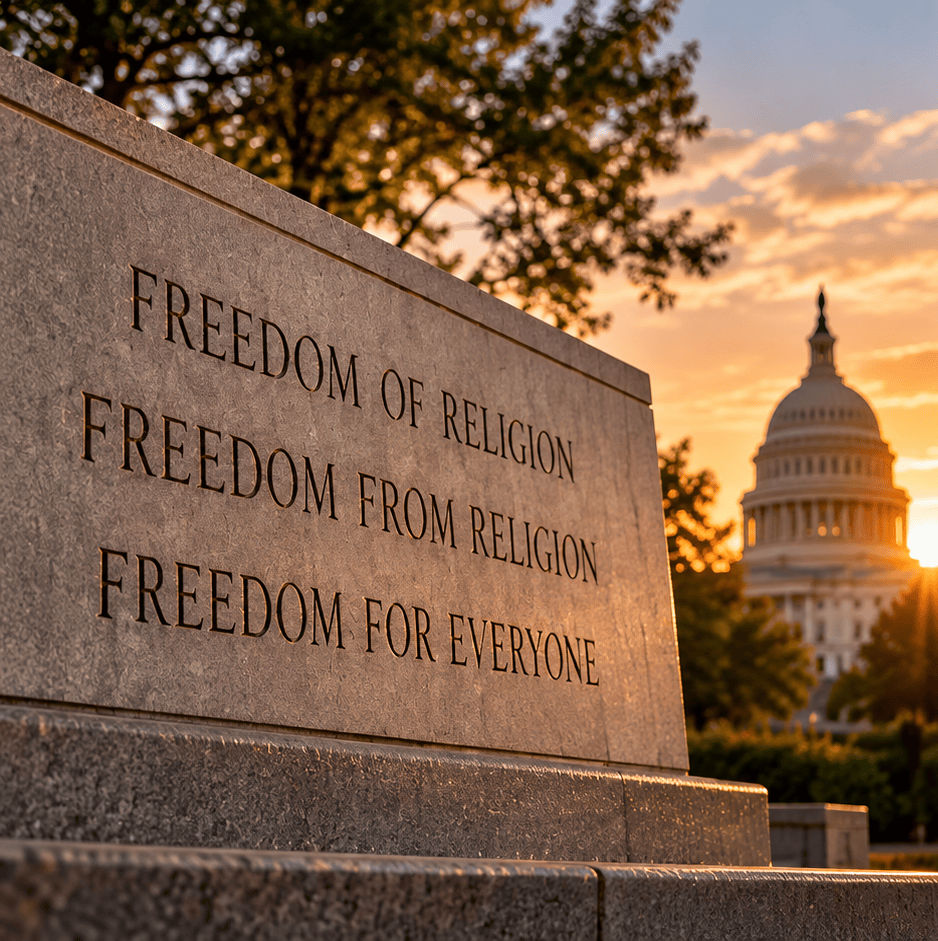
They weren’t all in agreement about religion. But the Constitution they produced contained something extraordinary: an explicit prohibition against religious tests for federal office.
Think about that.
Before the Bill of Rights was even adopted, the Constitution declared that no religious test would be required to hold federal office. Not a Christian test. Not a Protestant test. Not even a test requiring belief in a god.
The First Amendment subsequently prohibited Congress from establishing a religion or interfering with its free exercise.
That didn’t mean the founders created a perfectly secular society, or that religious discrimination disappeared. Far from it. But the federal government they established was not constitutionally reserved for Christians. And that distinction matters enormously.
A Question in Michigan
Recently, I watched a video of a confrontation at a town hall involving Dr. Abdul El-Sayed, a Muslim candidate for the United States Senate in Michigan.
A man stood up and demanded to know whether El-Sayed would disavow the Muslim Brotherhood.
El-Sayed responded by asking why the man felt compelled to ask him that question. The man didn’t offer an explanation. He simply repeated his demand.
El-Sayed quickly answered that he would disavow the organization and affirmed that his allegiance as a public official would be to the United States Constitution. Then he turned the question around, asking whether the man who questioned his loyalty would himself reject efforts to incorporate religious doctrine into American law.
The man said he would not.
And I found that exchange fascinating.
A Muslim candidate was being asked to demonstrate that his religion wouldn’t compromise his allegiance to the Constitution. Yet the person questioning him was unwilling to apply a comparable standard to his own religious convictions.
Why?
- Why should a Muslim have to prove that he can be a faithful American while a Christian is presumed to be one automatically?
- Why does one person’s religious allegiance make them suspicious while another person’s religious allegiance is a qualification for the job?
I suspect part of the answer lies in a belief I heard throughout my childhood: that America belongs, in some special sense, to Christians. And if you begin with that assumption, it’s not difficult to convince yourself that people who practice other religions are somehow less authentically American.
But that isn’t what the Constitution says.
Two Citizenships
There’s a concept familiar to anyone who has spent much time in evangelical Christianity: the Bible describes believers as “citizens of heaven”.
I understand that language. I taught and preached from the same Bible for years. And, for the record, I have no problem with someone believing that their ultimate spiritual allegiance is to God.
I’m a fan of dual citizenship. I believe the more principalities we attach ourselves to and pledge allegiance to, the better equipped we are to appreciate and uphold the cultures of those entities.
I absolutely think it can carry over to the biblical application of the concept too. Christians can be faithful citizens of heaven and faithful citizens of the United States. Those identities don’t have to be in conflict.
But serving in government introduces a responsibility that private religious belief does not.

When someone takes an oath to support and defend the Constitution of the United States, that oath carries obligations to people who don’t share the officeholder’s religion.
A Christian legislator might believe that certain conduct is sinful. A Muslim legislator might believe that certain practices violate Islamic teaching. A Jewish legislator might observe religious obligations that other Americans do not recognize.
That is their prerogative and they are all entitled to those beliefs.
They are also entitled to bring their moral convictions into public debate, just as people without religious beliefs do. But none of them acquires or retains the authority to disregard the Constitution simply because they believe their religious convictions come from God.
The authority of a public official comes from the Constitution, not from the official’s personal understanding of divine authority.
That doesn’t require anyone to renounce their faith. It requires them to recognize that their faith does not confer governmental authority over everyone else’s conscience. And I believe that’s a distinction every candidate for public office ought to understand.
When Privilege Feels Like Persecution
This brings me back to something that has troubled me for years.
I frequently hear American Christians describe themselves as persecuted.
Sometimes the complaint involves prayer in public schools. Sometimes it’s same-sex marriage. Sometimes it’s the removal of religious displays from government property. Sometimes it’s simply the recognition that people of other religions, or no religion at all, deserve equal treatment.
Certainly, Christians could potentially experience genuine discrimination and constitutionally-mandated religious liberty must protect them just as it protects everyone else.
But disagreement with Christianity is not persecution. Neither is the government’s refusal to enforce Christian doctrine.
A person who is free to attend church, read the Bible, pray, evangelize, and worship without governmental interference has considerable religious freedom.
The fact that a neighbor doesn’t share those beliefs does not diminish that freedom. The fact that the government refuses to require that neighbor to live according to those beliefs does not diminish it either.
And this is where I see a troubling contradiction in some expressions of modern American Christianity.
The New Testament repeatedly prepares believers for suffering, rejection, and sacrifice. Jesus did not promise his followers that they would control the government, dominate the culture, or enjoy permanent political influence.
In fact, it was quite the opposite.
Yet much of the political rhetoric I hear from Christian nationalist movements seems devoted to preserving Christian cultural authority and portraying its decline as persecution.
That raises a theological question as well as a constitutional one: at what point did following a faith centered on sacrifice become a demand for political privilege?
Whose Freedom Are We Defending?
On a surface level, I have no desire to prevent Christians from serving in government.
Nor do I believe Muslims, Jews, Hindus, Satanists, atheists, or anyone else should be excluded because of their religious convictions—or lack of them.
Yes, I said Satanists. If we’re serious about religious freedom, we don’t get to limit it to religions we find comfortable. In fact, the prohibition against religious tests is one of the things I most admire about the Constitution.
But I do believe we should ask difficult questions of anyone seeking public office.
- Will you protect the constitutional rights of people whose beliefs you consider wrong?
- Will you uphold laws that protect religious practices you personally reject?
- Will you recognize that your religious convictions, however sincerely held, do not give you the authority to deny other Americans their constitutional rights?
Those are fair questions. And they should be asked of Christian candidates just as readily as Muslim candidates. Which brings me to the this thought I can’t seem to shake:
Perhaps the real test of religious liberty isn’t whether the government protects the religion you practice. It’s whether you’re equally willing for the government to protect the religion you reject.
That is a much more demanding understanding of religious freedom than simply insisting that the government protect my religion.
It requires recognizing that freedom belongs to people whose beliefs may offend us, confuse us, or contradict everything we’ve been taught.
And it means accepting that the same Constitution protecting my right to worship also protects someone else’s right to worship differently—or not worship at all.
A Country for All of Us
My understanding of Christianity has changed considerably over the years. So has my understanding of America. I don’t believe the United States was established as a Christian nation in the constitutional sense I was taught growing up. I believe it was established as a nation in which Christians could practice their faith without the government requiring everyone else to practice it with them.
That’s not hostility toward Christianity. It’s religious liberty. And it is a principle that protects Christians just as surely as it protects Muslims.
In fact, Christians should have a particular interest in defending that principle. The freedom that protects an unpopular minority today may be the very freedom their own religious community needs tomorrow.
The Constitution doesn’t promise that Christians will always hold political power. It doesn’t promise that American culture will always reflect Christian beliefs. It doesn’t promise that Christians will always get their way.
What it promises is something both more modest and more profound: a system of government in which religious identity is not supposed to determine who belongs.
So perhaps we should return to the question that started all of this:
Is losing the power to impose your religion the same thing as losing the freedom to practice it?
I don’t believe it is. And until we understand the difference, I fear we’ll continue confusing religious freedom with religious privilege. And that’s no way to run a country.

