
Randomly Rudimentary Life Stuff
Learning to live authentically, and not settling for substitutes or counterfeits, and sharing those thoughts
The Same Right to Be Wrong About God
By LONNIE KING
It started, as most of my profound theological reflection so often does these days, with an Instagram reel.
The video showed a man named Corbyn Quick speaking before the McKinney, Texas City Council. He introduced himself as someone raised in a Bible-believing Baptist church, a Navy veteran who had served as a chaplain aboard a ballistic missile submarine, and someone who had studied the Bible and Christian theology at Liberty University.
In other words, he wasn’t exactly strolling into the room carrying credentials from the Society for the Abolition of Christianity.
And yet, in his video, he found himself addressing a room apparently filled with Christians who had been expressing hostility toward Muslims in their community.
And he said something that stopped me—and drew boos from the audience—as he spoke at the council’s public session.
Islam, he pointed out, teaches the virgin birth of Jesus.
Wait. What?
Apparently There Was a Hole in My Sunday School Education
I grew up Baptist, and I don’t mean casually Baptist.
My dad was a Baptist pastor. My grandfather was a Baptist pastor. I attended Baptist churches, worked for a while in Baptist churches, went to a Baptist college and spent enough time around fundamentalist Christianity to know precisely what we believed about people who didn’t believe what we believed.
And there was one thing that we ‘knew’ better than most other things: Muslims were firmly in the “them” category. So, somewhere along the way, I absorbed the idea that Muslims didn’t believe in Jesus.
Except that it’s just not true.
The Quran explicitly describes Mary asking how she could have a child when no man had touched her. Islam teaches that Jesus was miraculously born to the virgin Mary.
Let me clear, though. Muslims regard Jesus as the Messiah and one of God’s great prophets. They believe he performed miracles. But, they don’t believe Jesus is God. They don’t accept the Christian doctrine of the Trinity. Their understanding of the crucifixion is radically different from Christianity’s.
Those aren’t minor disagreements, but “Muslims don’t believe in Jesus” is still wrong.
And I found myself wondering how I had made it to 65 years old, after spending a significant portion of those years around Christianity, without really knowing that.
But, maybe that’s what happens when we learn more about what we’re supposed to believe about other people than learning about what those people actually believe.
He Said Something More Important
The Islamic theology lesson wasn’t really the point of Quick’s remarks. But he didn’t hesitate long in making his point.
“I never expected that I’d find myself in a room brimming with believers trying to tell them about the teachings of Jesus like they forgot.”
Ouch.

Quick reminded the Christians in the room of Jesus’ command to love their neighbors. Then he reminded the Americans in the room about the Constitution.
Now, those are actually two separate arguments. And he knew that.
As a Christian, I may have a religious obligation to love my Muslim neighbor. As an American, I have an obligation to recognize that my Muslim neighbor possesses exactly the same religious liberty I do. The second one doesn’t depend upon the first.
You can be an atheist and defend religious liberty. You can be Jewish and defend a Muslim’s religious liberty. You can be Muslim and defend a Christian’s religious liberty. And, yes, you can believe with absolute conviction that Jesus Christ is the only way to God and still defend a Muslim’s right to believe you’re completely wrong about that.
That’s not compromising your faith. That’s America.
The Same Right to Be Wrong
Maybe this is where we’ve made religious liberty unnecessarily complicated.
You don’t have to believe your Muslim neighbor is right about God to believe he has exactly the same right to be wrong about God that you do.
Read that again, if necessary, because here’s the inconvenient part: he probably thinks you’re wrong.
That’s how religious disagreement works. Christians believe Jesus is divine. Muslims believe Jesus was a great prophet and Messiah but not God. Jews generally reject both Christian and Muslim claims about Jesus. Atheists may look at the whole argument and wonder why the rest of us can’t find something productive to do with our Tuesday afternoon.
America doesn’t require us to settle the argument. America requires government to stay out of the business of declaring a winner.
When Theology Becomes Something Else
This is where the current political climate bothers me. We’re no longer talking merely about Christians believing Islam is theologically wrong. There are elected officials and candidates openly using Muslims as a cultural and political threat.
Outgoing U.S. Rep. Andy Ogles of Tennessee has gone so far as to say, “Muslims don’t belong in American society.” And, here in Texas, we’ve heard warnings about the “Islamification” of Texas, Sharia law and even “Sharia compounds.”
At that point, we’ve crossed a line.
“I believe Islam teaches things that aren’t true” is a religious conviction.
“Muslims don’t belong in American society” is something entirely different.
One is theology. The other is exclusion. And when people with governmental power begin suggesting that a particular religious group is inherently less American, religious preference starts drifting toward cultural oppression.
That’s when the rest of us ought to pay attention. Especially Christians.
Christians Would’ve Been “Them”
I’ve been thinking a lot lately about the origins of Christianity.
Christianity began as a Jewish movement. Jesus was Jewish. His disciples were Jewish. The earliest followers of Jesus in Jerusalem were Jewish. Then along came Paul, carrying an astonishing proposition into the Gentile world.
You can belong too. You don’t have to become Jewish first. You don’t have to be circumcised. You don’t have to assume an ethnic identity that isn’t yours. The circle is bigger than you thought.

For those of us who aren’t Jewish, that’s kind of an important development.
We were the “them.” Gentile Christianity exists because somebody insisted that the outsiders could be brought inside. Which makes it particularly ironic when Gentile Christians become obsessed with deciding who the new outsiders should be.
Apparently humans are remarkably good at being invited inside the circle and immediately asking where we can put up the fence.
Maybe That’s the Part Jesus Was Trying to Tell Us
I’ve spent a lot of my life hearing Christianity reduced to a relatively simple formula:
- Jesus died
- He was buried
- He rose again
- Believe that and be saved
I still understand why those claims matter so deeply to Christians. I’m not dismissing them.
But as I’ve grown older, I’ve become increasingly interested in something else:
What did Jesus tell people to do while they were still alive and why do the people who claim to be his followers pay so little attention to it?
- Love your neighbor
- Love your enemy
- Care for the poor
- Welcome the stranger
- Forgive
- Show mercy
- Stop worrying quite so much about who deserves a seat at the table
The Good Samaritan is particularly inconvenient here because Jesus deliberately makes the religious outsider the hero of the story. The respectable religious people walk past the wounded man, but the outsider stops.
Maybe Jesus understood something about our tendency to divide humanity into “us” and “them.”
The Boogeyman of the Week
Quick had another line that stuck with me. He accused political leaders of cycling through the “boogeyman of the week.”
Last year Latinos. This year Muslims. Next year trans people, autistic people, left-handed people or, as he jokingly added, “short kings.” It’s funny until you recognize the machinery underneath it.
Fear is politically useful. Find a group people don’t understand particularly well, then describe them as threatening. Tell everyone that those people are responsible for something they’re afraid of losing, then promise protection.
The identity of “them” can change. The strategy doesn’t have to.
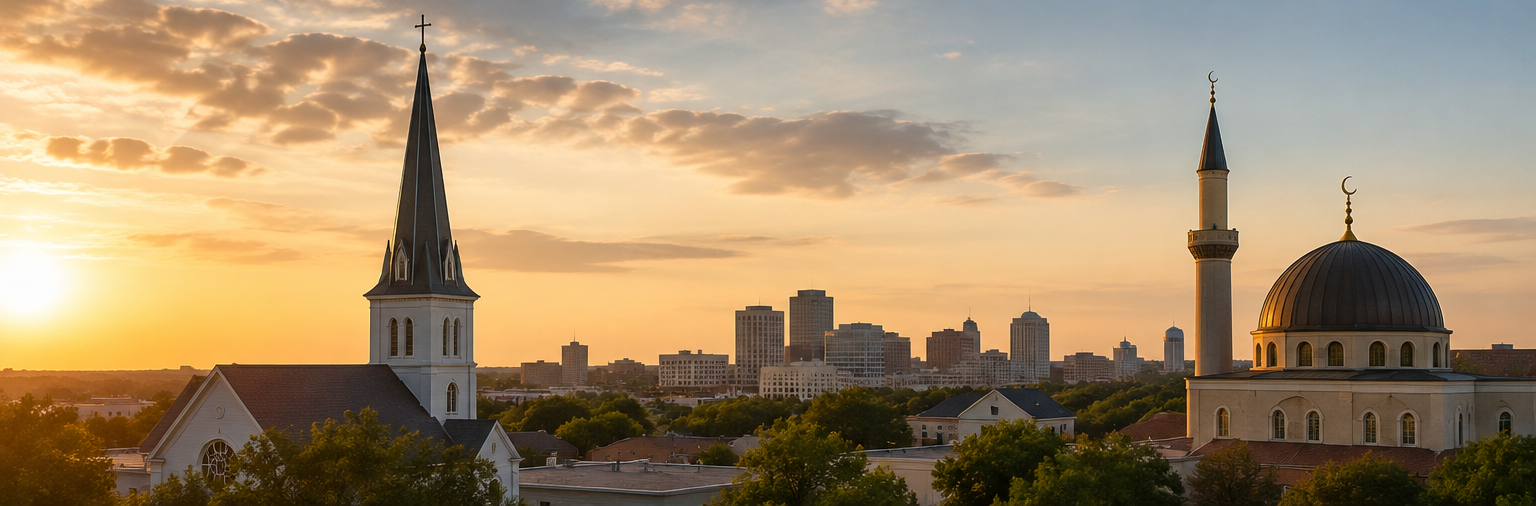
That’s why Quick’s closing observation deserves more attention than the Instagram algorithm will probably give it: “Villainizing our neighbors gives us nothing to believe in.”
Maybe that’s the whole thing.
Who Is My Neighbor?
Christians are perfectly free to believe Islam is wrong. Muslims are perfectly free to believe Christianity is wrong. And I’m increasingly comfortable admitting that there are things about both Christianity and my own understanding of God that I don’t know with anything approaching the certainty I once claimed. But there’s something I don’t find particularly complicated.
My neighbor doesn’t have to pass my theological examination before becoming worthy of my respect. And my government certainly shouldn’t administer those tests.
Maybe Corbyn Quick walked into that McKinney City Council meeting expecting to defend Muslims. Maybe he influenced some folks in the room with him. I don’t know.
But I do know, at least for this old former Baptist kid watching an Instagram reel, he raised a much more uncomfortable question about Christianity: if our faith gives us certainty about who’s going to heaven, but leaves us looking for people to exclude here on earth, exactly what did we learn from Jesus?
Sometimes, I think, not much.

