
Randomly Rudimentary Life Stuff
Learning to live authentically, and not settling for substitutes or counterfeits, and sharing those thoughts
Your Dog Isn’t on the Ballot: Why Independent Journalism Matters
By LONNIE KING
Victor Marx had been asked a straightforward question, even if it was not an easy one.
Marx, a Republican candidate for governor of Colorado, had made a series of extraordinary claims about his life. He said he had rescued thousands of women and children, confronted human smugglers, participated in more than a hundred high-risk missions and, as a civilian, helped call in a military strike that killed 70 ISIS fighters.
Journalist Kyle Clark wanted to know how voters could verify any of it.
Marx did not provide records or witnesses. Instead, he pointed toward Reagan, the dog sitting beside him. She had been in Syria and Iraq, he said. Was she lying, too? Then he joked that she might bite Clark.
Clark did not take the bait.
“The dog’s not running for governor,” he replied. “You’re running for governor.”
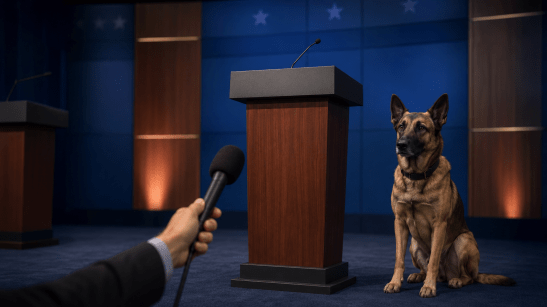
In eight words, Clark summarized something much of American political journalism seems to have forgotten.
The person seeking power owes the public answers.
The journalist’s responsibility is to keep asking until voters understand what has been answered, what has been evaded and what the available evidence actually shows.
Put another way: Your dog isn’t on the ballot.
The Microphone Is Not a Megaphone
Too many political interviews have become little more than opportunities for candidates to repeat prepared messages. A question is asked. The politician delivers a talking point that may have little to do with it. The interviewer moves on.
Nothing has been clarified. No claim has been tested. The audience has learned only what the politician’s campaign wanted it to hear.That is not necessarily journalism. Sometimes it is simply public relations with a network logo in the corner.
The journalist’s responsibility is not to preserve a candidate’s comfort. It is to preserve the public’s ability to distinguish a documented fact from a rehearsed assertion.
That requires preparation. It requires listening closely to the answer rather than merely waiting to ask the next question. Sometimes it requires a follow-up. Occasionally, it requires the journalist to say plainly: “That is not true. Where is your evidence?”
That is not political advocacy. It is the work.
Mike Lindell and the Premise Beneath the Question
Mike Lindell, the MyPillow founder and longtime promoter of Donald Trump’s false claims about the 2020 election, is now running for governor of Minnesota.
During an interview with MinnPost, Lindell again insisted that elections conducted with computers cannot be trusted. When the interviewer challenged his claims rather than accepting them as the premise for further discussion, Lindell became angry.
That reaction has become familiar.
A politician makes an unsupported assertion. A journalist points toward the evidence. The politician responds as though the challenge itself proves that the media are hostile.
It is a remarkably effective propaganda defense. The person making the unsupported claim becomes the victim. The person requesting evidence becomes the aggressor.
But a responsible journalist cannot ask how a supposedly stolen election should be corrected without first establishing whether it was stolen. Otherwise, the question itself lends credibility to something the evidence does not support.
The microphone is not supposed to function as a megaphone.
The Question Is Not the Attack
Before you assume my perspective only applies to people and platforms I agree with, let me be clear: this standard should not depend on the political party of the person being questioned.
After former Democratic senator Bob Menendez of New Jersey was convicted of accepting bribes, including cash and gold bars, he emerged from his sentencing hearing and adopted some familiar language.
“President Trump is right,” Menendez told reporters. “This process is political, and it’s corrupted to the core.”
A reporter immediately noticed the contradiction.
“You’re a Democrat,” the reporter said. “The case was brought by Democrats. How is this a witch hunt?”
Menendez did not explain. He simply repeated his claim that the process was political and corrupt. But, that question did not demonstrate hostility toward a Democrat. It demonstrated that someone in the press corps was listening closely enough to recognize a contradiction.
The examples may not be distributed equally between the parties at any particular moment. Fairness does not require pretending that every political problem always exists in identical proportions on both sides. What fairness requires is a consistent standard.
Whether the politician is Mike Lindell, Victor Marx or Bob Menendez, the journalist’s obligation remains the same:
- Listen to the answer.
- Compare it with the evidence.
- Notice the evasion.
- Ask again.
“You’re Either Crooked or You’re Stupid”
Kristen Welker provided another example during her recent Meet the Press interview with President Trump.
Trump repeated his claims that American elections are rigged. Welker reminded him that he had never presented evidence establishing that.
Trump did not respond with evidence. Instead, he attacked the journalist.
“You’re either crooked or you’re stupid,” he told her.
Welker responded calmly: “Let’s continue.”
Trump continued calling Welker, Meet the Press and multiple news organizations “crooked.” The discussion eventually ended with Trump removing his microphone and walking away.
The contrast told us more than another uninterrupted answer would have.
Welker questioned a factual assertion. Trump questioned her character and intelligence. She returned to the subject. He returned to the insult.
Trump attacks male journalists, too. But his treatment of women who challenge him often has a recognizably personal and gendered quality. He comments on their intelligence, disposition, appearance or professional legitimacy. A question about his conduct becomes an argument about the woman asking it.
Powerful, egotistical men are often particularly uncomfortable when a woman publicly refuses to accept their version of events. The purpose of the insult is not necessarily to win the factual argument. It is to raise the personal cost of asking the question.
Welker continued anyway. That matters.
Independence Does Not Mean Having No Opinions
Journalists are human beings. They have experiences, assumptions, values and opinions.
Independence does not require a journalist to arrive without any of those things. It requires a commitment to verification that is stronger than the desire to protect a preferred politician or punish a disliked one.
The best political journalists are not trying to defeat the candidate standing before them. They are trying to prevent an unsupported claim, convenient contradiction or rehearsed piece of propaganda from reaching the public unchallenged.
They do not tell voters what conclusion they must reach. They put relevant facts on the table so voters can reach an informed conclusion for themselves.
That is also why I am uneasy about Bari Weiss serving as editor-in-chief of CBS News.
My concern is not simply that Weiss has opinions. It is that she has built a public identity around a particular diagnosis of what American journalism gets wrong and the ideological direction in which she believes it should move.
Perhaps she will prove my concern misplaced. I hope she does.
But an independent newsroom cannot become an instrument for correcting one perceived political imbalance by creating another. “Balance” cannot mean choosing facts or framing stories according to the direction leadership wants the country to move.
Journalism should not begin with the desired conclusion. It should begin with the question and follow the evidence wherever it leads.
Who Protects the Person Asking?
A journalist can withstand an insult from a politician.
It is much harder to withstand an employer that values access, ratings or ideological alignment more than the journalist’s willingness to follow the facts.
An independent press therefore requires more than courageous reporters. It requires editors, executives and owners who will protect those reporters when powerful people complain.
Politicians can decline interviews. They can deny access. They can attack a network, threaten its licenses, file lawsuits or encourage supporters to distrust individual reporters.
Those pressures make institutional independence more important, not less.
The journalist sitting across from a president or candidate needs to know that asking a necessary follow-up will not be treated by newsroom leadership as a failure to remain “balanced.”
Sometimes the most truthful question will sound adversarial because the person being questioned is determined to evade it.
The discomfort is not always evidence that journalism has gone wrong. Sometimes it is evidence that journalism has finally begun.
The Test for the Rest of Us
Readers and viewers have responsibilities, too.
We cannot demand that journalists challenge propaganda from politicians we oppose and then accuse those same journalists of bias when they challenge someone we support.
The test of our belief in an independent press comes when the uncomfortable question is directed toward our candidate.
Do we still want the interviewer to ask for evidence? Do we still admire the follow-up question?Do we still believe an evasion should be identified? Or did we only want journalism to be aggressive when it could be used as a weapon against the other side?
Kyle Clark was not running against Victor Marx. Kristen Welker was not Trump’s political opponent. The reporter questioning Bob Menendez was not responsible for his conviction. The MinnPost interviewer did not create Mike Lindell’s election claims.
Each journalist simply refused to let the politician replace an answer with a performance.
The dog may be friendly…or not. The story may be moving. The grievance may be sincerely felt. The insult may successfully dominate the next news cycle.
But none of those things answers the question.
Your dog isn’t on the ballot. The person asking for power is.

