
Randomly Rudimentary Life Stuff
Learning to live authentically, and not settling for substitutes or counterfeits, and sharing those thoughts
Happy 4th: “Christian Nation” and Other Fairy Tales
By LONNIE KING
Every Fourth of July, somewhere between the potato salad and the fireworks, someone will confidently declare that “America was founded as a Christian nation.”
It’s usually delivered the way you’d deliver the weather: not as an opinion, but as a fact. A settled point. A done deal.
And in the current religious and political climate we live in here in these United States of ‘Murica—now 250 years into this experience—the folks who want to proclaim this seem to be even more emboldened and willing to shout their claim a little louder than before. It is almost as if they are determined to make sure we hear it, know it and accept it.
There is just one minor problem with that. The people who actually wrote the deal—the Declaration and the Constitution—seem to have missed that memo. And many of them didn’t identify as ‘Christian’.
Most were deists, to be sure, but that did not automatically put them in the camp that many uneducated loudmouths lump them into today.
The God Who Made The Footnotes
If the United States was meant to be explicitly Christian, you would expect the founding documents to read at least a little more like a church bulletin.
It seems like we could count on a section in the Constitution to dictate which Bible colleges our presidents needed to come from, or which biblical doctrine our cabinet-level Director of Christianity needed to hold most dear. Should they be Calvinists or Arminians?
Instead, that God-fearing lot ignored those weighty matters and focused the nation’s by-laws on the opposite.
The Declaration of Independence does refer to a “Creator,” “Nature’s God,” and “Divine Providence” in the most theologically vague way possible.
It’s reverent the way a Hallmark sympathy card is reverent: sacred references with lots of capital letters but conspicuously lacking in doctrinal detail. Unlike Hallmark, though, the authors didn’t leave room at the bottom for us to pencil in our own references to Jesus.
Then we get to the United States Constitution, the actual operating manual for the government, where any religious language almost completely vanishes.
No mention of Jesus. No “Christian” anything. Not even really a generic “God” reference. Talk about your humanist publication!
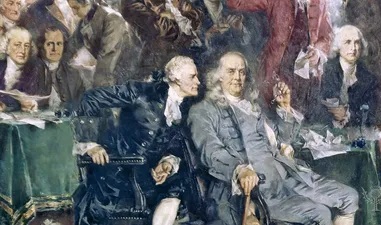
What you do get are guardrails…against religious favoritism. Congress is forbidden from making any law “respecting an establishment of religion, or prohibiting the free exercise thereof.”
No national church, no state-sanctioned creed, no religious test for public office.
If this is a “Christian nation,” it’s a strange one: its foundational contract never quite manages to say the quiet part out loud.
Those devout “Christian” founding fathers seemed to have been asleep long before asking Jesus to take the wheel.
Culturally Christian, Constitutionally Cagey
Still, early America was overwhelmingly Christian in culture. Churches dotted the landscape. Sermons shaped public life. The founders grew up in a world where the Bible was quoted more often than the weather report.
But there is a difference between being born in a Christian neighborhood and writing a Christian constitution. The founders did the former; they very deliberately did not do the latter.
They took a population that was mostly Christian and built a framework that refused to put Christianity—or any other faith—on the government’s official letterhead.
That gap between culture and constitution is where this whole conversation actually lives.
Meet The Deists (Your Founders May Already Be One)
When you look at the religious beliefs of several key founders, the picture gets even more interesting. Quite a few were not orthodox Christians in any way a modern evangelical pastor would recognize, or like.
They lived in the world of Deism and its cousins: the idea of a rational Creator who made the universe, endowed humans with reason, and then let them sort things out without dropping miracle-of-the-week episodes on demand.
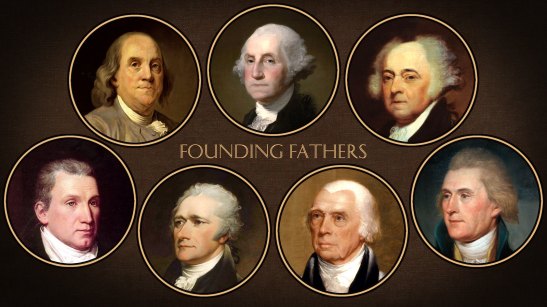
In that world, “Nature’s God” is not the God of the altar call so much as the God of the physics lab—more concerned with order and reason than with denominational membership rolls.
Thomas Jefferson And The Edited Jesus
Take Thomas Jefferson. If America was meant to be a straightforward Christian project, Jefferson is a very odd project manager.
He famously produced his own version of the Gospels, carefully editing out the miracles and divine claims so that Jesus would behave himself like a great moral teacher and not, inconveniently, God. Jefferson admired Jesus’ ethics and mostly sidestepped Jesus’ theology.
He could not sign off on the Christian doctrine of the Trinity. He doubted the divinity of Christ. He treated the resurrection like that awkward story your family doesn’t bring up at Thanksgiving. And yet, he’s the guy referencing a “Creator” and “Nature’s God” in the Declaration.
The language he gives us is deliberately broad enough to accommodate his skepticism, his neighbor’s orthodoxy, and the occasional village skeptic who just wanted everyone to calm down.
And he didn’t just talk about religious liberty in theory. In Virginia, Jefferson drafted the Statute for Religious Freedom (eventually passed with James Madison’s help) which banned tax support for churches and argued that “Almighty God hath created the mind free,” a line that made a lot of persecuted Baptists say a very loud amen.
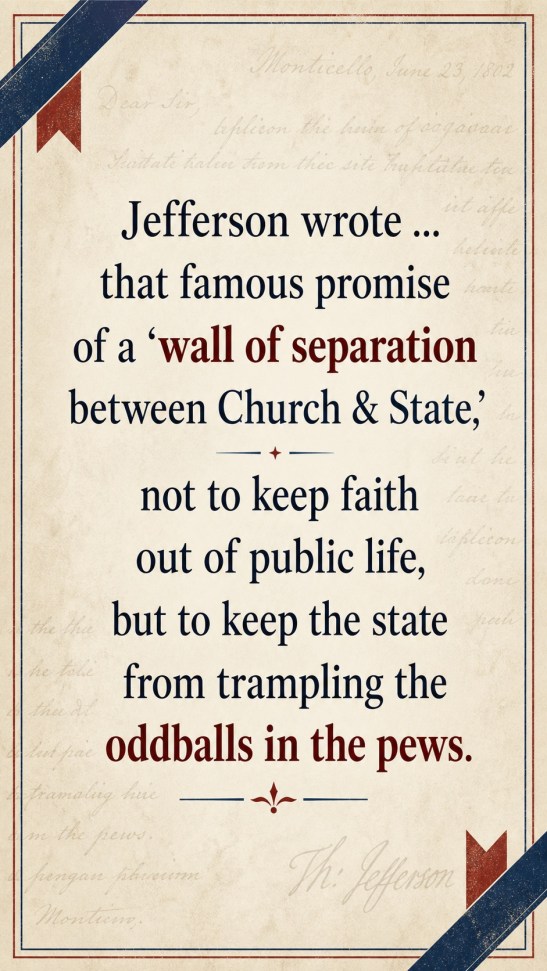
A few years later, when the Danbury Baptist Association in Connecticut wrote to him as a small, nervous minority complaining that whatever religious privileges they had were “favors granted, and not as inalienable rights,” Jefferson wrote back with that famous promise of a “wall of separation between Church & State,” not to keep faith out of public life, but to keep the state from trampling the oddballs in the pews.
Benjamin Franklin And The Church Of Practical Virtue
Then there’s Ben Franklin, patron saint of bifocals, paper money, and a gently-roasted clergy.
Franklin believed in a Creator, in moral law, and in a world ordered by divine wisdom. He also believed that much of organized religion was more interested in policing doctrinal minutiae than in producing actual virtue.
He attended church at times, but he was famously impatient with sermons that didn’t translate into doing good in the real world. For Franklin, the real test of faith was whether it made you a better neighbor, not whether you signed off on a catechism.
If you’re designing a government with Franklin in the room, you don’t write a specific creed into law. You build a system that protects everyone’s conscience and lets virtue rise or fall based on how people actually behave.
James Madison And The Wall Around The Pulpit
Madison, architect of much of the Constitution and the Bill of Rights, grew up in a religiously charged Virginia and watched state-backed religion in action. It did not impress him.
He saw what happens when government and church become entangled: dissenters fined, minority denominations harassed, clergy effectively on the state payroll. None of that looked like a recipe for either genuine faith or stable politics.
Madison concluded that the safest path was a wall: government on one side, religion on the other, free to influence each other through persuasion rather than coercion.
So when he put pen to parchment, he wrote explicit bans on religious tests and establishments. That wasn’t an oversight. It was the point.
In other words, while Jefferson was the guy sending reassurance letters to odd little Baptist churches looking for a place of protection to huddle up against, Madison was sketching the blueprints for a wall around the pulpit that the federal government could not legally penetrate.
George Washington: Religiously Vague On Purpose
George Washington is often presented as Exhibit A for the “Christian nation” narrative: a man who attended church, invoked Providence, and called for national days of thanksgiving.
But read his public prayers and proclamations closely, and you notice something: his God-language is almost always generic. Providence. The Almighty. The Great Author. Very rarely does he get down to denominational brass tacks.
Washington understood he was speaking not just to Anglicans or Congregationalists, but to Baptists, Quakers, Catholics, Jews, skeptics, and anyone else trying to survive this new experiment.
So he wrapped his faith in expansive language that could comfort the devout without writing unbelievers into the legal margins.
The Founders’ Faith: Not Quite Sunday School
Historians sometimes describe several founders as “theistic rationalists”—people who believed in a powerful Creator, saw religion as useful for moral order, but refused to be boxed in by traditional doctrines like the Trinity, the deity of Christ, or biblical inerrancy.
They were definitely not atheists. But they were not standard-issue evangelicals either. They sat somewhere in between: convinced there was a God, deeply impressed with reason, and suspicious of anyone swinging a Bible as a political weapon.
When that kind of mind writes a constitution, you get a document that protects religious liberty without endorsing religious specifics. It’s a theological tent big enough for the Puritan, the Deist, and the “I’ll-get-back-to-you-on-all-that” citizen.
The Treaty That Says The Quiet Part Out Loud
If you want a single, blunt piece of evidence, you don’t have to rely on creative interpretation. You can just read the plain language of the 1797 Treaty of Tripoli, ratified by the Senate and signed by President John Adams.
One article of that treaty states that “the Government of the United States of America is not, in any sense, founded on the Christian religion.”
Is that the whole story of America’s religious character? No. Treaties have context. But it is remarkable that less than twenty years after the Revolution, the new government was comfortable putting that sentence in an official document and sending it out into the world.
At minimum, it tells us the founders did not believe they were presiding over a formally Christian state. They thought they were building something else.
Why The “Christian Nation” Story Hangs On
So if the documents are cagey, the founders are complicated, and the treaty language is blunt, why does the “Christian nation” narrative still have such a strong hold?
Part of it is nostalgia. It’s comforting to imagine that your current political preferences were carved into stone tablets by the founding fathers themselves.
Part of it is confusion. People blur together “most early Americans were Christians” with “therefore the government is officially Christian.” That’s like saying because most of your neighbors drive pickup trucks, the HOA bylaws must have been divinely revealed in a Ford owner’s manual.
And part of it is power. If you can convince everyone that your particular brand of faith enjoys constitutional VIP status, it makes your arguments sound less like opinions and more like sacred obligations.
But there’s another piece we almost never say out loud: early America looked overwhelmingly Christian because the people who practiced other religions were either pushed out, locked up, or never allowed in.
The Native nations who were here first were labeled “savages.” Their worship, stories, and rituals were treated as obstacles to clear, not as faiths to respect. You don’t count a religion you’re busy erasing.
Africans dragged here as slaves were defined in law as property, not persons. And property does not get a box for “religion” on the census. Whatever they believed (African traditional faiths, Islam, emerging Black Christianity) didn’t shape the “official” picture because the official picture refused to see them as full human beings.
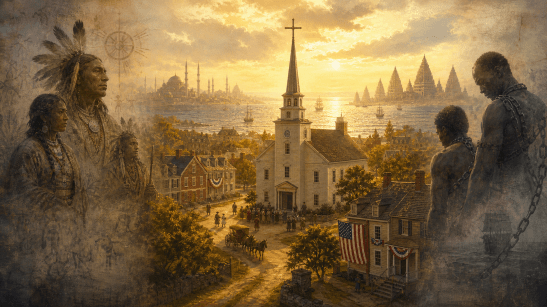
Meanwhile, the British Empire was busy subjugating people across the Middle East, Africa, and South Asia. Muslims, Hindus, and others were being controlled by the same imperial power that fed this continent, not invited as equal partners in some grand religious experiment. There was no open door for significant numbers of those communities to come here as free citizens and plant their faith alongside everyone else’s.
So yes, the early United States looked “culturally Christian.” It was a culture built largely by Europeans, on stolen Native land, with enslaved African labor, under an imperial system that kept most other religions an ocean away. When you control who gets counted as human, and who even gets to show up, it’s easy to act like your religion simply “won” the culture by divine right.
That’s not divine inevitability. That’s history. And once you see that, the phrase “Christian nation” sounds less like a pious description and more like a very selective memory.
Faith, Freedom, And Fireworks
None of this means Christians have no place in American public life. Quite the opposite. The founders’ arrangement assumes that people of all faiths—and those of no faith—will bring their deepest convictions into the public square.
The difference is that the government is not allowed to pick a favorite hymn while it’s doing its job. It can protect your right to worship; it cannot require everyone else to join your worship team.
On the Fourth of July, I can be grateful for both: for the heritage of faith that shaped many early Americans, and for a constitutional order that refuses to turn any one faith into federal policy.
That tension isn’t a bug. It’s the feature that lets a genuinely pluralistic country share a holiday without having to share a creed.
A Better Birthday Story
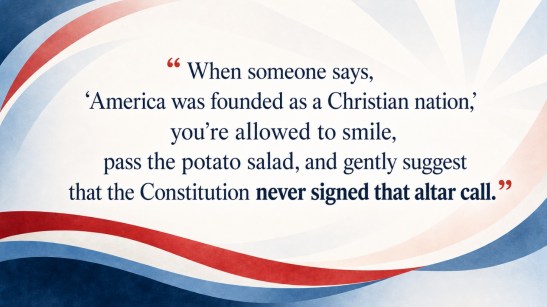
So this year, when someone says, “America was founded as a Christian nation,” you’re welcome to smile, pass the potato salad, and gently suggest a revision:
America was founded by a mostly Christian people, led by a mix of Christians, Deists, and theological free agents, who deliberately wrote a constitution that refused to make Christianity—or any religion—the official sponsor of the republic.
You don’t have to agree with their theology to appreciate their restraint.
And you don’t have to flatten their complexity into a bumper sticker to celebrate the birthday of the country they built.
Happy 4th!

