Randomly Rudimentary Life Stuff
Learning to live authentically, and not settling for substitutes or counterfeits, and sharing those thoughts
Faith, Hope, and the Things We Cannot Fully Know
By LONNIE KING
There was a time in my life when I believed faith meant certainty. Not just confidence. Not trust. Certainty.
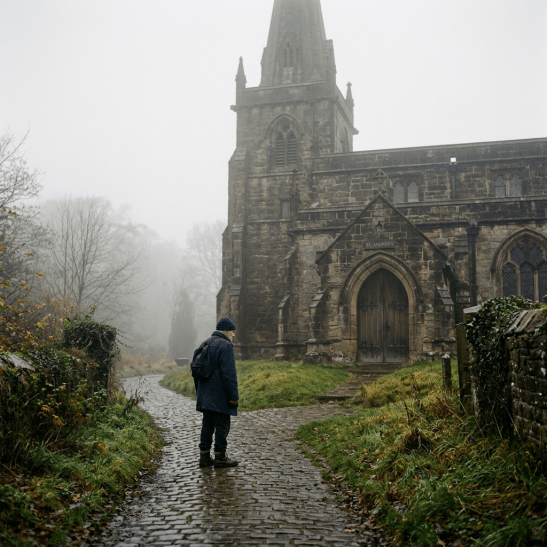
I was taught that real faith meant never wavering, never questioning, never admitting doubt.
If you struggled with uncertainty, the implication was that your faith was weak. Strong Christians “knew.” Weak Christians wrestled.
But now, the older I get, the more I wonder if we’ve turned faith into something the Bible itself never intended it to be.
When Faith Became a Flex
I’ve noticed that in some modern Christian circles, faith is almost treated like a spiritual flex.
The person with the strongest faith is often assumed to be the person who sounds the most certain: no doubts, no hesitation, no ambiguity, no wrestling. Everything becomes absolute.
- “I KNOW God told me this.”
- “I KNOW exactly what scripture means.”
- “I KNOW who is right with God and who isn’t.”
And honestly, I’m not sure that posture reflects humility as much as it reflects confidence. Maybe even overconfidence.
Because when I read, “Faith is the substance of things hoped for, the evidence of things not seen…” I no longer hear, “Faith is proof that uncertainty no longer exists.”
In fact, I hear almost the opposite. Faith exists precisely because there are things we cannot fully know.
Hope Requires Uncertainty
The more I think about it, the more I realize hope itself assumes incomplete knowledge. You don’t hope for things you already possess with total certainty.
You hope for what you long for. You hope for what you trust toward. You hope for what you cannot yet fully prove.
That’s why I struggle with the modern tendency to redefine faith as certainty itself.
I think faith is what helps human beings cling to hope because certainty remains out of reach. Not because uncertainty has disappeared.
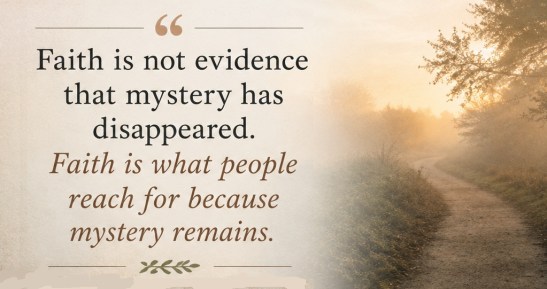
In other words, faith is not evidence that mystery is gone. Faith is what people reach for because mystery remains.
Seeing Through a Glass Darkly
In First Epistle to the Corinthians, Paul writes:
“For now we see through a glass, darkly…”
That does not sound like someone claiming total understanding. It sounds like someone acknowledging limitation.
Partial vision. Incomplete understanding. Human beings trying to make sense of things larger than themselves. And yet modern Christianity sometimes treats uncertainty itself as failure.
Questions become threatening. Doubt becomes dangerous. Ambiguity becomes suspicious. So, people learn to perform certainty publicly even while privately wrestling with fear, confusion, and unanswered questions.
The Job Conversation
Recently, a person quoted from the Old Testament book of Job to me, “I KNOW that my redeemer lives…”
The argument was that faith creates certainty. But my response was probably not what they expected.
I asked, “How do we know Job himself was a literal historical figure?”
How do we know the story wasn’t wisdom literature, allegory, or a poetic narrative written to encourage suffering or oppressed people?
After all, before we even get to Job’s declaration, we are already exercising faith:
- faith that the story was preserved accurately
- faith that translators captured the original intent
- faith that ancient writers were communicating truthfully
- faith that centuries of interpretation got things right
In other words, the certainty many of us are taught to feel is still built on incomplete evidence—evidence we cannot possibly prove with total certainty thousands of years later. Which means that at some level, we are all still relying on “the evidence of things hoped for.”
In other words: faith.
That observation did not go over particularly well. Apparently, asking sincere questions about how we know what we know is enough these days to get someone quietly labeled a heretic.
Maybe Faith Was Supposed to Make Us More Humble
Here’s where I keep landing: if faith exists because our understanding is incomplete, then faith should make us more humble—not more arrogant. More compassionate—not more judgmental. More thoughtful—not more combative.
Because if all of us are operating at least partially through trust, hope, interpretation, and incomplete understanding, then maybe we should hold our conclusions with a little more gentleness.
I’m not saying truth doesn’t matter. I’m saying human beings have always had limited access to perfect understanding. And maybe faith was never supposed to eliminate that tension. Maybe faith was supposed to help us live honestly within it.
Why Love Outlasts Faith
One of the passages I keep coming back to is where Paul says, “And now abides faith, hope, charity, these three; but the greatest of these is charity.”
That verse strikes me differently now than it once did. Because one day, if revelation is complete, faith and hope become unnecessary.
You no longer need faith for what is fully seen. You no longer need hope for what has fully arrived.
But love remains. Love is the eternal thing, which makes me wonder if we’ve elevated faith into something it was never meant to be.
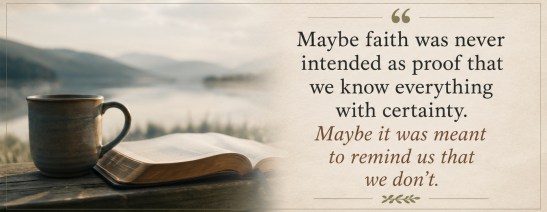
Maybe faith was never intended as a badge proving we know everything with certainty. Maybe it was meant humbling…to remind us how much we don’t know.
And maybe the real test of faith is not whether it makes us sound more certain than everyone else.
Maybe the real test is whether it makes us more loving while we live with uncertainty.
Grace and grit to you! —LK

