
Randomly Rudimentary Life Stuff
Learning to live authentically, and not settling for substitutes or counterfeits, and sharing those thoughts
The Sad Moment When American Politics Became Spiritual Warfare
By LONNIE KING
This morning I read another political fundraising email.

Honestly, it wasn’t even especially outrageous by modern standards. In fact, parts of it were rooted in legitimate concerns. The email warned that corporations are using AI and personal data in troubling ways and urged readers to donate money to stop political opponents from helping them continue.
But what struck me wasn’t the policy argument. It was the emotional tone.
The message wasn’t really: “Here’s a problem we should thoughtfully address as a society.”
The message was: “The enemy is already attacking you. If we don’t stop them now, everything gets worse.”
And the more I thought about it, the more I realized this is no longer unusual in American politics.
It’s standard operating procedure.
Every election is “the most important election of our lifetime.” Every opponent is an existential threat. Every loss is national catastrophe. Every disagreement becomes evidence that someone secretly hates America.
I’m old enough to remember when politics didn’t always feel this way.
Republicans and Democrats absolutely disagreed in the 1970s and 1980s. Sometimes bitterly. But most people still seemed to operate from the assumption that the other side loved America too — they just disagreed on what would help it thrive.
Now disagreement increasingly feels like warfare. And honestly, I don’t think that shift happened by accident.
When Disagreement Became Moral Combat
I know nostalgia can distort memory. The America of the 70s and 80s wasn’t perfect. There were ugly political moments then too: Vietnam, Watergate, racial tension, Cold War paranoia, fights over abortion and civil rights.
But there was still, generally speaking, a difference between, “I think your ideas are wrong,” and, “I think you are evil.”
That distinction matters more than we sometimes realize.
Politics once felt more like argument. Now it feels like moral annihilation. And when every election is framed as a final battle between good and evil, compromise begins to look like betrayal.
You can hear it everywhere now:
- “They hate America.”
- “They want to destroy the country.”
- “If they win, freedom dies.”
- “This is spiritual warfare.”
That last phrase catches my attention in particular because of my background. I grew up in evangelical Christianity. And for my entire lifetime, evangelical culture has frequently framed life itself in terms of warfare.
The Language of Spiritual Warfare
If you grew up in that world, you know the language by heart.
- “We wrestle not against flesh and blood.”
- “The battle for the soul of America.”
- “Taking America back for God.”
- “The enemy is attacking the family.”
- “Stand firm against the powers of darkness.”
I grew up hearing verses like 2 Chronicles 7:14 (KJV) — “If my people, which are called by my name, shall humble themselves, and pray, and seek my face, and turn from their wicked ways; then will I hear from heaven, and will forgive their sin, and will heal their land” — applied directly to America’s political and cultural struggles.
It was rarely framed as merely personal spiritual reflection. More often, it carried the implication that Christians were engaged in a battle for the nation itself.
And over time, I believe something happened: the spiritual warfare mindset merged with partisan politics.
Not all at once. Not in every church. Not among every believer. But enough to reshape the emotional tone of political discourse in America.
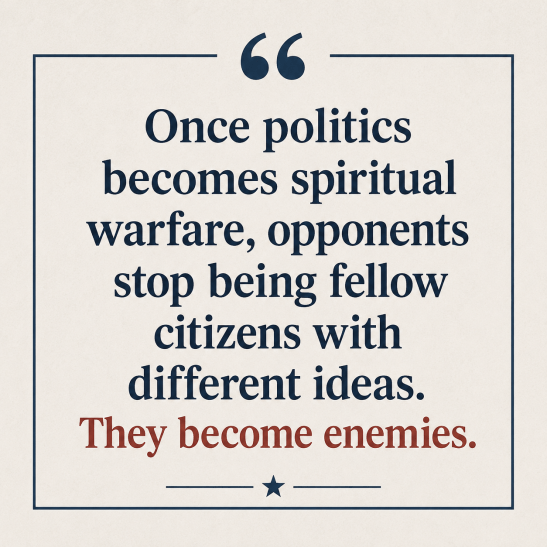
Because once politics becomes spiritual warfare, opponents stop being fellow citizens with different ideas. They become enemies.
Not just politically wrong. Spiritually dangerous.
And once you start viewing politics through that lens, everything escalates naturally:
- fear-based fundraising,
- apocalyptic rhetoric,
- conspiracy thinking,
- outrage culture,
- loyalty tests,
- suspicion of compromise,
- demonization of dissent.
After all, if you truly believe you are fighting evil itself, then coexistence can begin to feel morally irresponsible.
Younger Generations Inherited the Atmosphere
One of the saddest parts of this to me is that younger generations barely remember another kind of political culture.
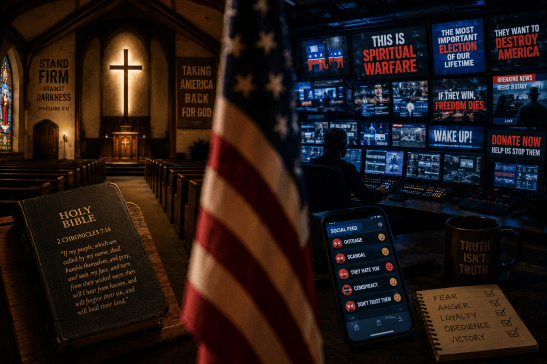
My kids grew up in an America where cable news runs on outrage, social media rewards humiliation, every election is framed as civilization-ending, and politics feels like permanent emotional combat.
To many younger Americans, this simply feels normal.
But I remember a time when political opponents were still often viewed as neighbors first and adversaries second. I remember a time when losing an election did not automatically mean half the country believed democracy itself had ended.
And I’ve already written before about wondering what happens to a society when distrust becomes the operating system. The more I watch modern politics, the more I think we may already be living inside that reality.
Because eventually people stop believing that institutions are honest, opponents are sincere, compromise is possible, or even that fellow citizens deserve grace.
Everything becomes tribe. Everything becomes suspicion. Everything becomes a battle.
(Related reading: When Distrust Becomes the Operating System)
The Problem With Permanent Warfare
To be clear, I’m not arguing that people of faith should avoid politics. Nor am I pretending that secular political movements don’t engage in their own forms of moral absolutism. They absolutely do.
Fear-based tribalism is now everywhere.
But I do think evangelical Christianity helped normalize the emotional framework of existential conflict in American politics. And once that framework took root, politicians of every kind learned how effective fear could be.
Fear raises money. Fear drives ratings. Fear builds loyalty. Fear keeps people emotionally activated.
But fear also corrodes trust.
A society cannot remain healthy forever if every disagreement becomes proof that someone is evil. At some point, democracy requires the ability to say: “I think you are deeply wrong, but I still recognize your humanity.”
That feels increasingly rare now.
Maybe We Need Fewer Warriors
I understand why people feel alarmed right now. There are legitimate concerns in America. Real injustice exists. Corruption exists. Dangerous people in leadership roles exist.
But when every issue becomes apocalyptic, eventually people lose the ability to think clearly at all.
Permanent warfare changes people—spiritually, emotionally, politically.
And honestly, I’m beginning to wonder whether one of the greatest losses in modern America is not simply political unity, but the loss of the ability to disagree without imagining ourselves at war.
Maybe what this country needs right now is not more warriors.
Maybe it needs more citizens — and I don’t mean ‘citizens of heaven’.
Grace and grit to you! —LK

