
Randomly Rudimentary Life Stuff
Learning to live authentically, and not settling for substitutes or counterfeits, and sharing those thoughts
When the Tool Becomes the Truth
By LONNIE KING
The other day I watched a video from Dan McClellan that stuck with me for a different reason than he probably intended.
I follow McClellan because I find many of his thoughts challenging and thought-provoking, even when I don’t completely agree with every conclusion he reaches. In this particular video, he was responding to a Christian influencer who had become emotional over a video clip of whales interacting underwater.
The influencer used the clip as evidence of divine creation and proof that atheism requires more faith than belief in God.
There was just one problem. The whale video was AI-generated.
And honestly, while McClellan made some strong observations on the influencer’s video-within-the- video, that’s the part I couldn’t stop thinking about.
Not the theology. Not the apologetics. Not even McClellan’s broader commentary about performative faith and identity politics.
What grabbed my attention was how quickly someone with influence accepted emotionally satisfying content as reality because it reinforced a worldview they already believed.
That’s not just a religious problem. That’s a human problem.
The Danger Isn’t AI
I want to be clear about something. I’ve seen and heard the fear-based warnings about artificial intelligence, but I don’t believe AI itself is inherently dangerous.
Like almost every tool humanity has ever developed, AI can be used for incredible things:
- Education
- Art
- Storytelling
- Scientific visualization
- Historical recreation
- Accessibility
- Creativity
- And, even helping us appreciate aspects of the world we might otherwise never fully see or understand.
Sometimes those things may even inspire awe in us. There’s nothing wrong with awe.
The problem is not that AI can create moving experiences. The problem is the motives of the people using it.
A tool is only as trustworthy as the integrity of the person holding it.
Broadcasting Taught Me This Years Ago
As someone who has spent years around sports broadcasting, this idea feels familiar to me.
A microphone is a tool. The question is not whether the microphone exists or whether sociey is better or worse off because of its invention. The question is whether the person speaking into it understands their responsibility to the audience.
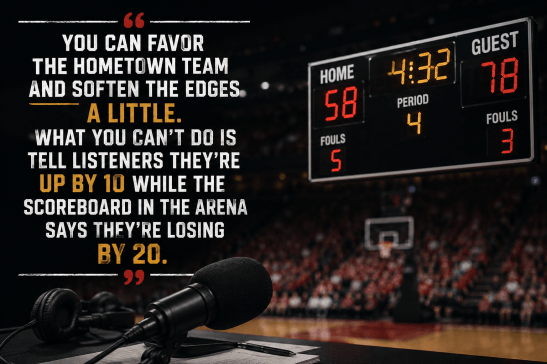
When I’m broadcasting a game for a team like the Houston Cougars, I understand that my audience is emotionally invested in the Cougars.
They want energy. They want perspective centered around their team. They don’t want to hear their players constantly berated on air.
But if I were hired to call the exact same game for a national broadcast, the expectations would change.
The audience would expect a more balanced presentation. Different emphasis. Different framing. Different responsibilities.
Neither role is inherently dishonest. But a different perspective is inevitable. Either way, integrity is still essential.
You can favor the hometown team and soften the edges a little. What you can’t do is tell listeners they’re up by 10 while the scoreboard in the arena says they’re losing by 20.
And that distinction matters more than ever now.
We’re Entering an Era of Synthetic Emotion
What does concern me about AI is not that it can generate fake images or videos. It’s that it can manufacture emotional experiences.
That whale video didn’t just communicate information. It manufactured wonder. And in a culture already driven by algorithms, outrage, tribalism, and emotional validation, that becomes incredibly powerful.
Especially when people become so attached to a worldview that they stop asking, “Is this true?” and begin asking, “Does this support what I already believe?”
That temptation exists everywhere—religion, politics, media, activism, sports, even everyday social interaction.
We all want reassurance that our tribe is right. AI can provide new ways to feed that desire. And people who are motivated to elicit those reactions can use AI to do just that.
The Real Human Problem
Ever since I first started hearing warnings about AI eventually taking over the world or replacing human beings, I’ve tried to do something other than panic about it.
I’ve tried to learn.
I’ve spent time using AI tools, reading about them, experimenting with them, and paying attention to both the excitement and the fear surrounding them. And the more I’ve done that, the more convinced I’ve become that the greatest danger is probably not the technology itself. It’s the human nature amplified by technology.
AI is a tool. Like broadcasting equipment is a tool. Or cameras. Or microphones. Or the internet itself.
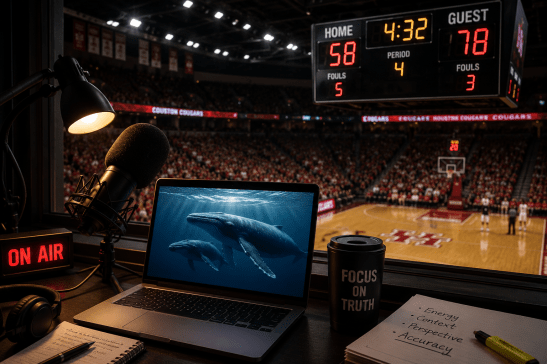
A tool can be used to assist, educate or manipulate. It can clarify or deceive. It can inspire curiosity or reinforce propaganda. But all of that depends far less on the tool than on the motives of the person using it.
And right now, we are living in a time where incredibly powerful tools are becoming available faster than wisdom is developing alongside them.
There are times technology creates mechanics who think they’re CAD engineers… and CAD engineers who think they’re mechanics.
Now, to be clear, I’m not arguing that people should “stay in their lane” forever. I actually believe the opposite. Expanding your horizons matters. Learning matters. Curiosity matters.
A mechanic can absolutely learn engineering principles. An engineer can absolutely learn hands-on repair work.
Growth is good. But meaningful growth requires humility. It requires the willingness to say, “I may not fully understand this yet.”
And that kind of restraint feels increasingly rare online.
Credibility Requires Restraint
One of the strangest realities of modern culture is that confidence is often rewarded more quickly than competence. The people who speak fastest and loudest frequently gain the most attention, even when they know the least.
But real credibility still requires something deeper: self-restraint.
It takes strength to admit you may not know everything you need to know about a subject. It takes discipline to slow down before reposting emotionally satisfying content. It takes maturity to study, learn, train, and remain teachable.
Having access to a tool does not automatically create wisdom. Having information does not automatically create understanding. Having a platform does not automatically create credibility.
Those things still have to be earned. And maybe that’s one of the biggest challenges we face moving forward: learning how to use increasingly powerful tools without allowing them to magnify our worst instincts.
Grace and grit to you! —LK

