
Randomly Rudimentary Life Stuff
Learning to live authentically, and not settling for substitutes or counterfeits, and sharing those thoughts
Reformation or Reconstruction?
By LONNIE KING
I have spent a lot of time over the last several years asking myself a difficult question: does American Christianity need another reformation? Or does it need something much more drastic than that?
I honestly do not know the answer anymore.
What I do know is that somewhere along the way, much of what passes for Christianity in America stopped looking like the movement Jesus seemed to create and started looking far more like an institution determined to preserve itself at all costs.
And I say that not as an outsider throwing rocks. I say it as someone who once desperately wanted to be part of the machine.
Wanting to Be “The Next Great Preacher”
There was a very brief time in my life when I genuinely wanted to become a great preacher. Not famous, necessarily. Not wealthy. But respected. Influential. Effective.
I believed in evangelical Christianity deeply enough to devote my life to it. I studied it. Defended it. Preached it. Tried to counsel people through it.
And for a long time, I thought the problem with the church was simply that people were not committed enough to biblical truth.
Now I wonder if the bigger problem was that many of us had become more committed to protecting the institution than protecting people.
The Meeting That Changed Everything
The beginning of the end for me came during my years in ministry.
A teenage boy in our church got his teenage girlfriend pregnant. His family attended church. Hers did not. Both families were devastated and angry. I found myself mediating a meeting between terrified parents and two scared kids who had just radically altered their futures.
At the same time, the church leadership already had a plan—the “biblical” solution.
The teenagers would publicly confess their sin before the church, promise not to repeat it, and get married immediately.
The problem was… they were just kids. A 17-year-old boy and a 16-year-old girl.
And no matter how many Bible verses people wanted to throw at the situation, I could not convince myself that pressuring two frightened teenagers into marriage was compassionate, wise, or loving.
It felt like institutional damage control disguised as righteousness.
I remember realizing in that moment that I was profoundly unprepared for what I was being asked to do. I had been trained in doctrine, apologetics, and church politics—but not in trauma, emotional maturity, adolescent development, or how to help real people navigate complicated lives.
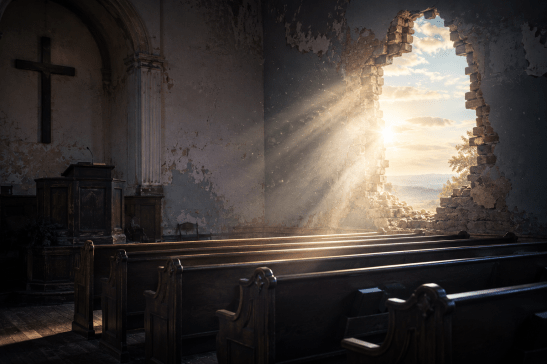
I also recognized that any ‘counselors’ among other pastors that I had surrounded myself with were absolutely more concerned with toeing the ‘company line’ than they were with these fragile teens.
In fact, in their minds the pair ‘deserved’ whatever they got because they had made irreversible choices that required consequences.
But maybe most importantly, I realized I could no longer tell people to do things simply because “that’s what the church teaches.”
Especially if I did not believe in my heart that it was the right thing to do.
When Compassion Becomes a Threat to the System
That was the moment I began quietly colliding with evangelical culture itself. It wasn’t long after that I dropped out of the ministry. But it didn’t bother those people much. Because once you start prioritizing compassion over rigid certainty, systems built on certainty become uncomfortable with you and, ultimately, you have to go.
Once you begin asking, “What will this do to these people emotionally?” instead of merely asking, “Does this preserve the church’s standards?” you start becoming dangerous to the institution.
I began noticing how often churches seemed more concerned with appearances, moral performance, doctrinal purity, and protecting authority than with the emotional and spiritual well-being of actual human beings.
And eventually I reached a painful conclusion: many churches no longer seemed organized around loving neighbors. They seemed organized around protecting the machine.
Jesus Started a Movement
The more I revisited the Gospels and the book of Acts, the harder it became for me to believe that Jesus intended to create what modern Christianity eventually became.
The early ekklesia looked less like an organized religion and more like a movement or community:
- shared possessions
- shared meals
- caring for vulnerable people
- mutual support
- transformed relationships
The earliest followers of Jesus did not even possess what we now call the New Testament Bible. They had stories, letters, memories, and communities centered around a person they believed changed everything.
Most of them were still practicing Judaism. Their relationship to Jesus existed within their culture and faith tradition—but it was not yet the institutional religion Christianity would later become.
And somewhere along the line, I think the movement slowly hardened into machinery.
From Movement to Empire
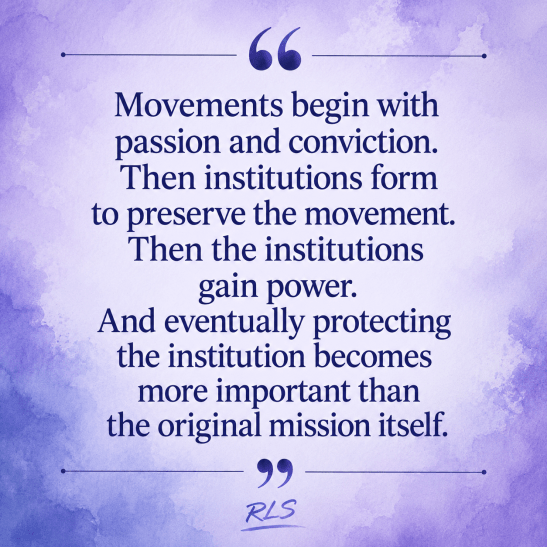
History shows this pattern over and over again. Movements begin with passion and conviction. Then institutions form to preserve the movement. Then the institutions gain power. And eventually protecting the institution becomes more important than the original mission itself.
By the time Martin Luther challenged the Catholic Church during the Reformation, the church had become deeply entangled with money, political power, hierarchy, and corruption.
Luther himself was not originally some revolutionary outsider. He was an insider—a monk and theologian who reached a breaking point because he could no longer reconcile what he was seeing with what he believed Christianity was supposed to be.
That part feels painfully relevant to me, because I think many people inside modern American evangelicalism are quietly reaching similar breaking points now.
This Isn’t Just About Churches
To be clear, I do not think this tendency is unique to Christianity.
Political parties do it. Corporations do it. Nonprofits do it. Media organizations do it. Even families can do it.
Movements begin with ideals and purpose. Then structures emerge to preserve those ideals. And eventually the structures themselves become the priority. Protecting the institution starts mattering more than fulfilling the mission that created it in the first place.
Religion is not uniquely guilty of this. It is simply the institution I knew from the inside. And perhaps that is why this subject still feels so personal to me.
Because once you begin noticing the difference between serving people and protecting systems, you start seeing that tension almost everywhere.
Reformation or Demolition?
Here is the question I cannot stop asking: can American Christianity still be reformed from within? Or has the institution become so intertwined with politics, fear, image management, certainty, celebrity culture, and power that it now requires a complete dismantling and rebuilding?
Honestly, I do not know. And maybe that uncertainty is healthier than pretending I have all the answers—at least that’s what I tell myself.
But I do know this: a faith built primarily around fear, control, and public performance no longer resembles the Jesus I encounter in the Gospels.
The Jesus I see there consistently prioritized people over systems. Mercy over performance. Compassion over religious theater. And if modern Christianity cannot square itself with those priorities, then maybe the problem is not that the world has drifted too far from the church.
Maybe the church drifted too far from the movement.
Grace and grit to you! —LK

