
Randomly Rudimentary Life Stuff
Learning to live authentically, and not settling for substitutes or counterfeits, and sharing those thoughts
Songs in the Key of Me: The Way It Is
By LONNIE KING
Not every song that shapes us arrives during childhood.
Some songs remind us of a specific time, place, or person. Others become part of our lives more gradually. They keep reappearing, carrying the same message while we slowly become different people.
Bruce Hornsby and the Range’s The Way It Is is one of those songs for me.
It was released in 1986, the year before I met Dawn. I don’t associate it with a particular season of our marriage, a memorable road trip, or one defining moment in my life.
It simply stayed with me from the moment I first heard it.
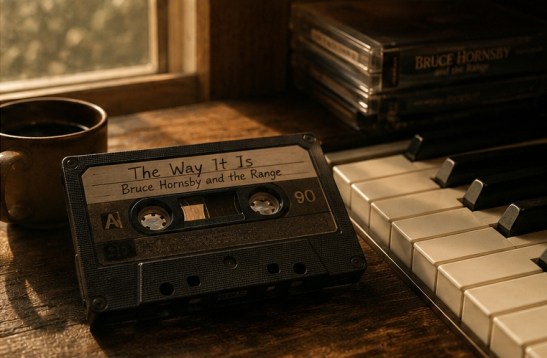
I was still listening to cassette tapes when the song came out. I later bought it on CD, but long before that, it had become one of the essential songs I included on mix tapes I made for myself.
And I never listened to only part of it. I listened from beginning to end.
In the days when car cassette players had auto-rewind, I would sometimes reach for the button as soon as the song ended.
The tape would whir backward, stop at the beginning, and I would listen to the whole thing again.
Looking back, I don’t think I was merely replaying a song I liked. I was returning to a conversation I had not yet learned how to articulate.
Learning How to Listen
There may be another reason the song always got my attention.
As a kid, I took piano lessons. I never became especially accomplished, and I was certainly never destined to play like Bruce Hornsby. But those years sitting on a piano bench gave me something I didn’t fully appreciate at the time.
They taught me how to listen.
Even now, when The Way It Is begins, part of me stops listening to the lyrics for a moment just to marvel at what Hornsby is doing on the keyboard.
The syncopation feels effortless. The rhythm never seems to sit still. His hands appear to dance across the keys while the rest of the band builds a groove around him that keeps pressing relentlessly forward.
I don’t just hear the melody. I hear the craftsmanship.
Hornsby comes across to me as a storyteller, and his style of piano playing is perfectly suited to the way he tells a story in song. The piano isn’t merely accompanying the lyrics. It is helping tell the story.
The Words Sound Like Resignation
If all you knew was the title, you might assume the song is resigned to the world as it exists.
“That’s just the way it is.“
How many times have we heard some version of that phrase?
- That’s just politics.
- That’s just business.
- That’s just human nature.
- That’s just how things have always been.
We often use those words when we have run out of either the imagination or the will to believe something could be different.
At first, the song’s refrain can almost sound like surrender. Some things never change. This is simply the way the world works. Accept it and move on.
But Hornsby doesn’t leave the thought there. He adds the quiet warning that changes the meaning of everything around it:
“Don’t believe them.“
He isn’t defending the status quo. He is exposing the language people use to preserve it.
People will tell you this is just the way things are. They may even insist that this is the way things will always be. But that doesn’t mean they are right.
The Question That Stayed With Me
The part of the song that has lingered with me most is the exchange between an older man and a young boy.
The adult tells the child that he cannot go where the others go because he does not look like they do.
There is no emotionally convenient resolution to the scene. The older man does not suddenly recognize the cruelty of what he has said. He does not apologize. The rules do not immediately change.
The child simply responds with a question: “Did you really think about it before you made the rules?”
That is such a simple question. It is also a dangerous one, at least to anyone whose authority depends upon rules never being examined.
The boy does not need to insult the man. He does not have to overpower him in an argument. He merely asks whether the rule was ever subjected to serious thought in the first place.
Was it created because it was right? Or was it inherited, repeated, and enforced because no one with enough authority had bothered to question it?
That question has echoed in my mind for decades.
The Music Refuses to Surrender
What fascinates me most is the way the music interacts with that unresolved story.
Imagine those same ideas presented as a slow, mournful ballad. The scene might feel hopeless. The older man has the authority. The boy is excluded. The rules remain in place. Nothing changes before the verse ends.
But Hornsby surrounds the story with music that refuses to stop moving. The piano keeps pushing. The rhythm section keeps driving. The tempo never surrenders. Even when the older man says no, the music seems to insist that the story is not over.

There is something relentless and almost unstoppable about it. The injustice is real, but it does not get the final word.
You can imagine that young boy walking away from the encounter still carrying his question, still searching for an opening, still believing there must be somewhere he can go.
The lyrics acknowledge the world as it is. The music keeps moving toward the world as it might become.
Maybe that is why I have never experienced the song as hopeless. It does not offer an easy triumph, but it refuses to sound defeated.
The Convictions I Had Been Given
When I first heard The Way It Is, I was still carrying around a lot of convictions that I had inherited rather than examined.
Like most of us, I assumed the adults who had shaped me had already done the hard thinking. They had determined what was true, which rules mattered, and which doctrines were supposed to be etched in stone. My responsibility was to accept what they handed me.
This song never told me all those convictions were wrong. It did something quieter than that.
It suggested that asking a sincere question was not necessarily an act of rebellion. It might be an act of responsibility.
Every time I heard that exchange between the older man and the child, the question planted itself a little deeper.
Did you really think about it before you made the rules?
I don’t believe I understood at the time how much that question would come to matter to me. But the song became one of many influences that kept prompting me to examine what I had been given.
- Were these convictions truly mine?
- Had I thought carefully about them?
- Did they remain worthy of my allegiance?
- Or was I repeating answers because someone had once told me those answers were beyond question?
The song didn’t overturn my beliefs overnight. Music rarely works that way. It simply kept the questions alive.
Maybe That’s Why I Kept Rewinding
There are songs that transport me immediately to one moment in my past.
The Way It Is does something different. It connects me to a process.
I first heard it while I was still discovering who I wanted to become as an adult. Then I carried it with me through cassette tapes, mix tapes, CDs, car stereos, and nearly four decades of living, listening, reconsidering, and growing.

The song stayed the same. I didn’t.
Over time, I began asking the young boy’s question of my own faith, my politics, my relationships, my parenting, and the assumptions I had become comfortable passing along to other people.
- Did I really think about it before I made the rule?
- Before I defended the doctrine?
- Before I repeated the answer?
- Before I told someone else where they could or could not go?
Don’t misunderstand me: not every inherited conviction deserves to be discarded. Some beliefs withstand honest examination and become stronger because we have examined them. But no belief becomes more truthful simply because someone carved it in stone before handing it to us.
Perhaps that is why this song has stayed with me for nearly forty years.
It isn’t because Bruce Hornsby told me the world was perfect. It isn’t even because he told me the world was broken. It’s because he reminded me that the world we inherit is not necessarily the world we are required to preserve unchanged.
Maybe that’s why I kept rewinding the tape.
I wasn’t just listening to a song. I was slowly becoming the kind of person who believed that questions aren’t the enemy of truth. Sometimes they’re the only way we ever get there.
Maybe that is just the way it is. But it doesn’t have to continue to be.

