
Randomly Rudimentary Life Stuff
Learning to live authentically, and not settling for substitutes or counterfeits, and sharing those thoughts
You Can’t Claim Scripture and Cherry-Pick It Too
By LONNIE KING
I came across a video recently that stopped me mid-scroll. Not because it was shocking, but because it was familiar.
The creator described a conversation about Paul, biblical authority, and what we expect people to do with those teachings. It wasn’t my conversation, but it might as well have been. I’ve seen versions of it play out enough times to recognize the pattern immediately.
In the video, the poster mentioned that her friend strongly defended biblical inerrancy, especially when it came to LGBTQ people being called to lifelong celibacy. But when the conversation turned to Paul’s words about singleness — that it can actually be the better path, a way of living with undivided devotion to God — everything shifted.
Suddenly, Paul’s words weren’t binding. They were dismissed. Not because they were unclear, but because they were inconvenient. And that moment captures something I’ve been wrestling with for a long time.
Convenient Until It Costs You
In many evangelical spaces, Paul’s words are often treated with a kind of functional authority that, in practice, can outweigh even the words of Jesus. Not in theory because most people would never say that out loud. But in how scripture actually gets used, Paul becomes the foundation for rules, especially around sexuality, while Jesus is more often referenced for tone, posture, or general moral vision.

This isn’t just a theological observation. It has real consequences.
Because when Paul is used to make binding claims about other people’s lives, but quietly set aside when his teachings become personally costly, it exposes something deeper than disagreement.
It reveals that what’s being called “biblical authority” is often something more selective.
I’ve written before that, despite what many Christians claim, no one actually believes or applies every part of the Bible uniformly.
Everyone interprets. Everyone prioritizes. Everyone, at some point, decides what is cultural, what is timeless, what is metaphor, and what is non-negotiable.
The difference is that not everyone is willing to admit it.
Name the Contradiction, Become the Threat
What struck me about the video wasn’t just the inconsistency. It was how quickly the conversation shifted once that inconsistency was named. The issue stopped being the substance of the question and became the perceived threat of asking it.
Words like “divisive” entered the space, along with insinuations of something darker — spiritual attack, even a demonic presence — as if simply naming an inconsistency was an attempt to destroy unity rather than understand truth.
Meanwhile, the question itself was never answered. It was written off.
And that is one of the core problems I have with American evangelical Christianity today. It cannot withstand questions. It does not know how to remain open when someone points out a contradiction.
Instead of wrestling with the discomfort, it reaches for spiritual language to shut the conversation down.
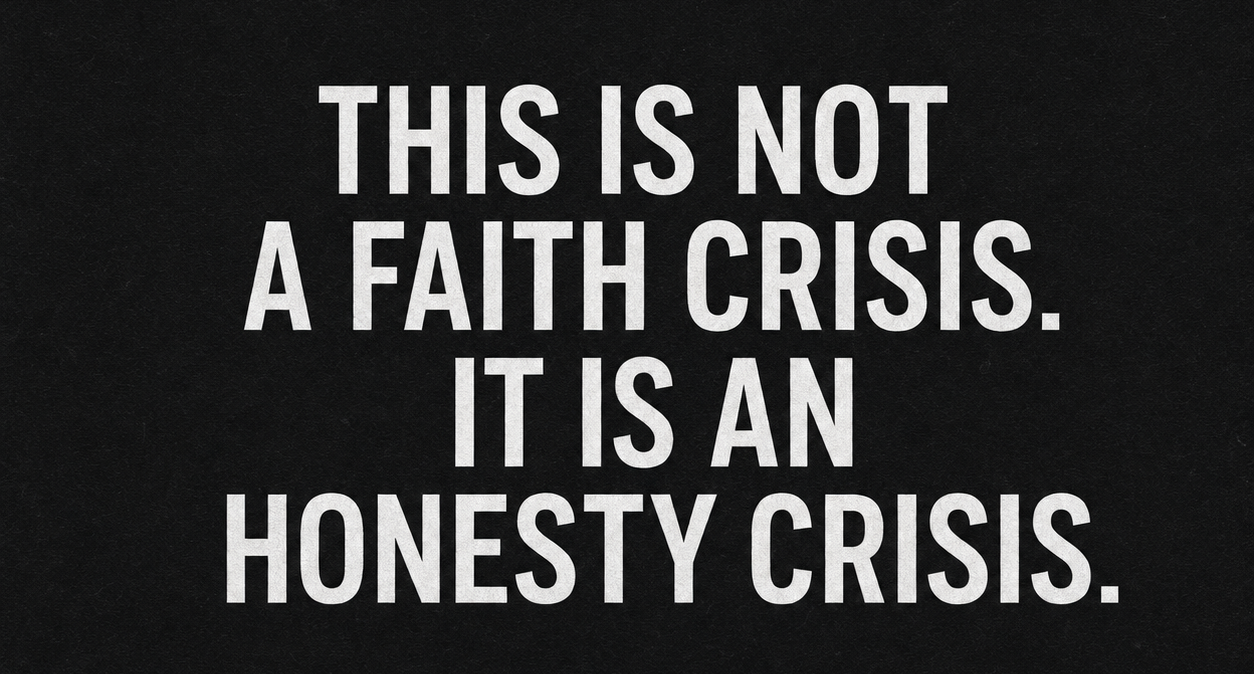
That is not discernment. It is deflection. And the question doesn’t indicate a crisis of faith. It indicates a crisis of honesty.
Unity That Requires Silence Isn’t Unity
This is where the whole thing becomes even more troubling to me.
If unity only exists when no one asks hard questions, then it isn’t really unity. It’s control. It’s a demand for agreement without honesty. It’s a fragile peace maintained by silence, suspicion, and the quick labeling of anyone who disrupts the room.
And the cost of that kind of unity is always carried by the person who asks the question.
A Question Is Not an Attack
I don’t think accountability is divisive. I think accountability is what keeps a community from collapsing under its own contradictions. But in these spaces, accountability is often treated like betrayal. A fair question becomes an attack. A challenge becomes evidence of spiritual danger.
That tells me more about the system than it does about the person asking.
This has become one of my deepest tensions with Christianity in America — not that it has answers I disagree with, but that it so often refuses to sit with the questions at all.
I Want a Faith That Can Handle the Truth
If you’re a regular reader of this blog, you read this before, but I want to be abundantly clear: this is not a rejection of faith in God or in Jesus.
It is, instead, a growing conviction that much of modern evangelicalism does not reflect what Jesus intended his ekklesia to be. A community shaped by Jesus should not be afraid of honest inquiry. It should be refined by it.
And yet, in too many churches, honest questions are treated as spiritual threats.
That is why this matters so much to me. Not because I want to win an argument, but because I want a faith that can survive the truth.
Grace and grit to you! —LK

