
Randomly Rudimentary Life Stuff
Learning to live authentically, and not settling for substitutes or counterfeits, and sharing those thoughts
The Broadcasters Didn’t Lose the Games: What Boston College Got Wrong
By LONNIE KING
When a new head coach takes over a struggling college basketball program, change is expected.
Assistant coaches leave. Playing styles change. Recruiting priorities shift. Team rosters turn over. New language is introduced. New expectations are established. Sometimes the locker room is remodeled, the uniforms are updated, and every visible part of the program receives what people like to call a fresh coat of paint.
Boston College certainly had reason to make basketball changes.
The Eagles finished the 2025-26 season with an 11-20 record, including a 4-14 mark in the ACC. Head coach Earl Grant was dismissed after five seasons and a cumulative record of 72-92.
That is the sort of performance that often leads an athletic department to replace a coaching staff.
It should not lead anyone to replace the broadcasters.
But at Boston College, the fresh start has reportedly extended all the way to the radio booth.
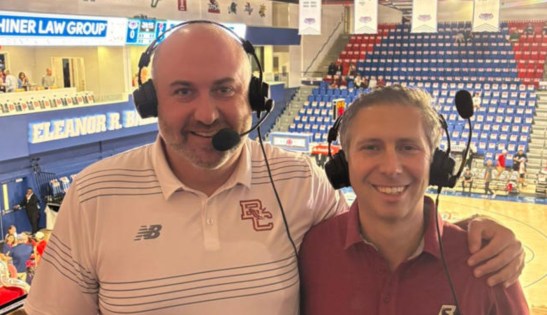
According to a report from Awful Announcing, longtime Boston College basketball broadcasters Kevin Collins and Josh Maurer were recently told they would not return for the upcoming season. Collins had been part of the broadcasts for 13 seasons. Maurer had worked alongside him for nine.
Boston College hired Luke Murray as its new head coach on March 26. In the nearly four months that followed, Collins and Maurer reportedly made repeated efforts to introduce themselves and begin building a relationship with him.
They never got the opportunity and the reported reason for their eventual dismissal is what makes the story so unsettling.
The broadcasters say they were told that Murray wanted no remnants of the previous program around him. They were apparently viewed as part of the “losing mentality” associated with the former coaching staff.
Boston College was 11-20 last season. But the broadcasters called those losses. They did not cause them.
If their account is accurate, the decision to remove them says far more about the new coach and the Boston College administration than it does about the two men behind the microphones.
Institutional Memory Is Not Institutional Failure
A broadcaster does not recruit players. He does not design the offense, determine the rotation, manage the locker room, or decide which defense to play after a timeout. He does not determine whether the team wins 25 games or loses 25.
He describes what happens.
A team broadcaster may travel with the program, develop relationships with coaches and players, and become familiar with the internal rhythms of a season. But he is not an assistant coach. His professional value should not rise and fall with the record of whichever coaching staff happens to be employed at the time.
Collins and Maurer had worked through multiple coaches and athletic directors. That does not make them responsible for the program’s disappointments. It makes them part of its institutional memory.
There is an important difference.
Longtime broadcasters know the history of a program. They know the people who have supported it through good seasons and bad ones. They know the traditions, the personalities, the turning points, and the stories that cannot be found in a media guide.
They also know the audience.
A confident new coach could view that knowledge as an asset. He could sit down with the broadcasters, ask questions, and learn something about the institution he has just joined. An insecure coach might see anyone who remembers the past as a threat to the future he wants to control.
Judged Without a Conversation
Perhaps the most revealing detail in the story is that the broadcasters reportedly tried for months to meet Murray.
They were not demanding hours of his time. They wanted an introduction and a brief conversation. Collins said they even offered to provide a catered lunch for the coaching staff in exchange for 15 minutes together.
That meeting never happened. Think about what that means.
If the broadcasters’ account is correct, Murray decided that they represented something undesirable without ever sitting across a table from them. He apparently formed a judgment about their mentality, their influence, and their suitability for the program without giving them an opportunity to introduce themselves.
That is not discernment. It is assumption. And deciding that someone is part of the wrong culture before speaking with him is not leadership. It is the refusal to lead.
One of the simplest tests of a leader is whether he is willing to encounter people as individuals instead of reducing them to categories. These broadcasters were apparently categorized as remnants of the previous regime. Once that label was applied, their years of service, professionalism, and knowledge no longer seemed to matter.
They became symbols of something Murray wanted to erase.
Broadcasters Are Not Members of the Coaching Staff

A team broadcaster occupies a slightly unusual position.
He is not an independent beat reporter. He works on a broadcast representing the school and naturally wants the program to succeed.
He travels near the team, talks with the coaches, and tells the program’s story to the people who care most about it.
But he is not employed to validate every decision made by the head coach.
The broadcaster serves the institution and its audience. His responsibility is larger than the comfort of the person currently occupying the head coach’s office.
Coaches come and go. Broadcasters sometimes remain. That continuity is valuable because college sports programs belong to more than the current coaching staff. They belong, in a less literal but more enduring sense, to alumni, students, supporters, former players, and generations of listeners who have followed the team through all kinds of seasons.
A broadcaster helps connect those generations. Treating the radio crew as an extension of the old coaching staff fundamentally misunderstands the role.
Relationships Change, but the Responsibility Remains
I understand that team broadcasters develop relationships with coaches.
I spent years broadcasting NCAA Division I basketball and traveling with the team. When you share buses, airplanes, hotels, practices, pregame meals, victories, and disappointing trips home, it would be almost impossible not to get to know the people involved and share some of the joy and pain they feel.
Sometimes those relationships become genuine friendships. At the very least, they usually become friendly professional relationships built upon familiarity and trust.
During my tenure, I worked with only one men’s head coach, but I worked with two different women’s head coaches. I valued all those relationships and tried to be protective and understanding of each one. I wanted the coaches to trust that I understood the pressures they faced and that I would represent them fairly.
But I also understood that my position did not belong to any one coach. My role as the team broadcaster was to promote the program to the audience.
That meant telling its story, helping listeners get to know its players and coaches, providing context for what was happening, and giving people a reason to remain connected. A good team broadcaster wants the program to succeed, but the program is larger than any one coaching staff.
When a new coach arrives, the broadcaster’s previous relationships should not automatically become evidence against him. A professional broadcaster understands how to establish a new relationship while respecting the one that came before it. In fact, navigating those transitions is part of the job.
A broadcaster who has served through multiple coaching changes can help introduce the new coach to the audience. He can provide continuity during a period of uncertainty. He can help supporters understand what is changing while reminding them that the larger identity of the program remains intact.
That is not allegiance to the past. It is service to the institution.

Any new coach who assumes that a broadcaster’s cordial relationship with the previous staff makes him incapable of supporting the next one fundamentally misunderstands both the profession and the people who practice it.
The Next Broadcasters Have Been Warned
Whoever replaces Collins and Maurer should be very careful about becoming too comfortable in the position while Luke Murray remains the head coach at Boston College.
That may not be very long.
Murray may turn the program around and enjoy a successful tenure. But what happens if Boston College goes 5-25 this season? Will the broadcasters be evaluated according to the quality of their work, or will someone decide that the new voices failed to create the proper winning atmosphere? Will the blame somehow fall on the way the games were called?
If that sounds ridiculous, it’s because it is ridiculous.
But once a coach or athletic department administration associates on-court success or failure with the people describing the games on the radio, we cannot logically rule out the possibility. If Collins and Maurer could be dismissed because they supposedly carried traces of the previous program’s “losing mentality,” their replacements should wonder what might be projected onto them when the next losing streak arrives.
The new broadcasters will also understand something else from the beginning: professional performance may not be enough to protect them.
They could prepare thoroughly, promote the program enthusiastically, treat the coaches and players fairly, and represent Boston College with complete professionalism. Yet if the head coach becomes uncomfortable with them, their work may not matter.
That is the chilling effect created by an arbitrary decision. It does not affect only the people being removed. It changes how everyone who follows them understands the job.
Instead of entering the booth with the confidence to serve the program and its audience, the replacements may feel pressure to serve the preferences of one coach. They may wonder whether an honest description of a poor performance will be interpreted as insufficient loyalty. They may become more concerned with preserving access than building credibility.
And if Murray eventually leaves, as nearly every coach does, they may discover that their close association with his tenure has suddenly become a liability under the next person hired to create another “fresh start.”
A broadcaster’s position should not depend upon whether the team is winning. It should depend upon whether the broadcaster is doing the job well.
Boston College’s decision has made that distinction much harder for the next voices of the program to trust.
When a Fresh Start Becomes a Purge
Every new leader wants the opportunity to establish a new culture. But there is a difference between changing the direction of an organization and removing everyone who remembers where it has been.
Wanting a “fresh coat of paint” may make sense when choosing assistant coaches, developing a recruiting strategy, or establishing expectations for the players. Extending that philosophy to longtime broadcasters begins to look less like renewal and more like a purge.
It suggests that the coach is uncomfortable with anything he does not completely control.
Strong leaders do not need to erase every connection to the past. They are secure enough to listen to people who possess institutional knowledge. They recognize that experience is not disloyalty and continuity is not resistance. They learn before they dismantle.
Murray has not yet coached a game for Boston College, but if this reporting is accurate, one of his first significant cultural statements has been that years of faithful service can be disregarded because a newcomer has attached the wrong symbolism to you.
That may establish authority. It does not establish trust.
The Institution Failed Them Too
Boston College issued a statement saying the decision was made by athletic department administrators in consultation with the school’s multimedia-rights partner. That may tell us who technically made the decision. It does not fully explain why it was made.
Nor does it answer the allegation that the new coach wanted the broadcasters removed. And if Murray did make that request, someone still had the responsibility to tell him no.
Administrators could have explained that broadcasters are not members of the coaching staff. The multimedia-rights partner could have defended two experienced professionals whose performance apparently was not the issue. Someone could have insisted that the coach at least meet the men whose livelihoods he was reportedly asking the institution to disrupt.
Instead, the broadcasters learned shortly before August that they would not be retained.

People outside the profession may not understand how damaging that timing can be. Full-season broadcasting assignments are usually arranged well in advance. By late summer, many of the comparable opportunities for the coming basketball season have already been filled.
This was not simply a matter of declining to renew two contracts. The timing may have cost these men most of a year’s income from college basketball. That consequence deserved more consideration than it apparently received.
Leadership Is Revealed by How We Treat People We Do Not Need
It is easy for a new coach to talk about standards, accountability, and culture. Those words appear at almost every introductory press conference.
But culture is not created by slogans. It is revealed through decisions, particularly decisions affecting people who possess less institutional power than the person making them.
A leader reveals himself by how he treats people he does not believe he needs.
Collins and Maurer reportedly asked only for an opportunity to meet the new coach. They wanted a conversation. They wanted the chance to demonstrate who they were instead of being judged by what Murray assumed they represented. They did not receive it.
That is the part of this story I find most difficult to overlook.
A new coach is entitled to build his staff, establish his philosophy, and take a struggling program in a different direction. But the broadcasters did not create Boston College’s losing record, and institutional memory is not the same thing as a losing mentality.
Removing two longtime professionals without even meeting them does not project confidence. It projects insecurity, misplaced blame, and an unhealthy desire for control.
The irony is that Murray apparently wanted to send a message that losing would no longer be tolerated. Instead, the message received by many people will be that loyalty, experience, and years of good work offer no protection when a powerful newcomer needs symbols of the past to discard.
That is certainly a statement from the new coach about culture. Just probably not the one he intended to make.

